Zones of LLM predictabilityfour days beforeAs you may know, large language models (LLMs) are smack dab in…
Makers and Magicians
The rise of makers2023It seems pretty obvious that there is some sort of cyclical nature…
Doers, Thinkers, and Magicians2023I’ve been reflecting on my experiences of working with developers and developer…
I want to finally connect two threads of the story I’ve been slowly building across several posts. I’ve talked about the rise of makers. I’ve talked about the magicians. It’s time to bring them together and see how they relate to each other.
First, let’s paint the picture a little bit and set up the narrative.
AI Developer Experience Asymptotes2023To make the asymptote and value niches framing a bit more concrete,…
Four layers2023There seems to be some layering rhythm to how software capabilities are…
The environment is ripe for disruption: there’s a new software capability and a nascent interface for it, and there’s a whole lot of commotion going on at all four layers of the stack. Everyone is seeing the potential, and is striving to glimpse the true shape of the opportunity, the one that brings the elusive product-market fit into clarity.
Dandelion/Elephant Strategy Rubric2022On the other hand, dandelions and the r-selected species they represent choose…
Strategy Aperture2023The concept of embodied strategy continues to captivate me. Recently, I found…
As I asserted before, there’s a brief moment when this opportunity is up for grabs, and the ground is more level than it’s ever been. Larger companies, despite having more resources, struggle to search for the coveted shape quickly due to the law of tightening aperture. Smaller startups and hobbyists can move a lot faster – albeit with high ergodic costs – and are able to cover more ground en masse. Add the combinatorial power of social networks and cozywebs, and it is significantly more likely that one of them will strike gold first.
Strategy and FOMO2022There’s this really fun neologism that the cool kids use: FOMO, or…
For any larger player with strategic foresight, the name of the game is to “be there when it happens”. It might be tempting to try and out innovate the smaller players, but more often than not, that proves to be hubris.
Instead of trying to be the lucky person in the room, it is more effective to be the room that has the most exceptionally lucky person in it – and boost their luck as much as possible.
When the disruption does finally occur and the hockey stick of growth streaks upward, such a stance reduces the chances of counter positioning and improves the larger player’s ability to quickly learn from the said lucky person.
Put simply, during such times of rapid innovation, the task of attracting “exceptionally lucky people” to their developer ecosystems becomes dramatically more important for larger companies.
The story of an opportunity2021While geeking out on this idea of coherence and possible mechanisms that…
If the story indeed is playing out like so, then the notion of magicians is useful to identify those “exceptionally lucky people” – because luck compounds for those who explore the space in a way that magicians do.
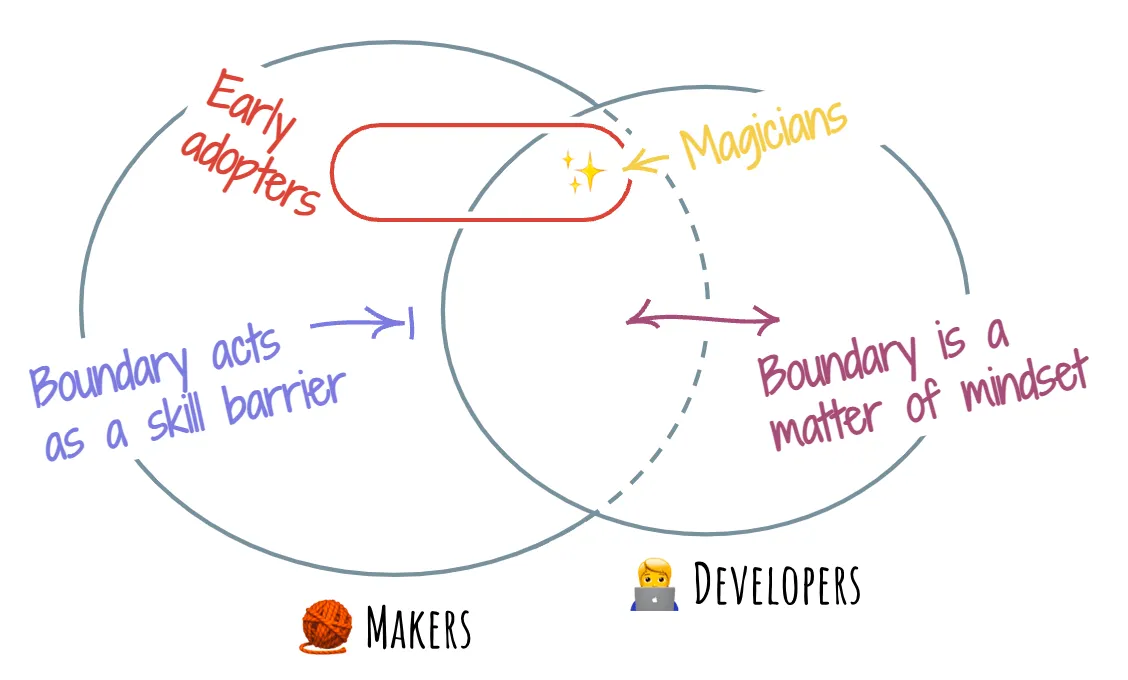
But where do makers fit in? A good way to think of it as overlapping circles of two groups: developers and makers.
Developer surface2021I mentioned this concept before, and I feel like it’s worth expanding…
We’ll define the first circle as people who develop software, whether professionally or as a hobby. Developers, by definition, use developer surfaces: APIs, libraries, juts, tools, docs, and all those bits and bobs that go into making software.
The second circle is broader, because it includes folks who both develop and interact with software in a way that creates something they care about. Makers and developers obviously overlap. And since “maker” is a mindset, the boundary between makers and developers is porous: I could be a developer during the day and a maker at night. At the same time, not all developers are makers. Sometimes, it’s really just a job.
No ship ums2023I’ve been thinking about the path that software dandelions take toward becoming…
Makers who aren’t developers tend to gravitate toward becoming developers over time. My intuition is that the more engaged they become with the project, the more they find the need to make software, rather than just use it. However, the boundary that separates them from developers acts as a skill barrier. Becoming a developer can be a rather tough challenge, given the complexity of modern software.
Traits of a maker mindset2023The whole concept of makers has been on my and my colleagues’…
Within these two circles, early adopters make up a small contingent that is weighted a bit toward makers. Based on how I defined maker traits earlier, it seems logical that early adopters will be primarily populated by them.
A tiny slice of the early adopter bubble on the diagram is magicians. They are more likely to be in the developer circle than not, since they typically have more expertise and skill to do their magic. However, there are likely some magicians hiding among non-developer makers, prevented by the learning curve barrier from letting their magic shine.
Why AI orchestration11 days afterWhy do I find the problem of AI patterns and more generally,…
Aircraft Carriers and Zodiac Boatslinks here, 2024The first group of folks succeeded accidentally. The second – intentionally. This…
I hope this diagram acts as a navigational aid for you in your search for “exceptionally lucky” people – and I hope you make a room for them that feels inviting and fun to inhabit.
Show 2 comments
Dew Drop – October 24, 2023 (#4053) – Morning Dew by Alvin Ashcraft linked here · October 24, 2023
[…] Makers and Magicians (Dimitri Glazkov) […]
Noé · November 6, 2023
So relatable! Feeling less lonely in this wonderful struggle.
Keep up the cool insights
Best