The Breadboard developer cycle

Over the past couple of months, we’ve been working on a bunch of new things in the Breadboard project, mostly situated around developer ergonomics. I’ve mentioned creating AI recipes a bunch in the past, and it might be a good time to talk about the mental model of how such recipes are actually created.

❤️‍🔥 Hot reload 

One of the Breadboard project design choices we’re leaning into is the “hot reload” pattern. “Hot reload” is fairly common in the modern developer UX, and we’d like to bring it into the realm of AI recipes. In this pattern, the developer sees not just the code they write, but also results of this code running, nearly instantaneously. This creates a lightning-fast iteration cycle, enabling the developer to quickly explore multiple choices and see which ones look/work better.

Most “hot reload” implementations call for two surfaces that are typically positioned side by side: one for writing the source code, and another for observing the results. In Breadboard today, the first one is typically an editor (I use VSCode) and the second one is our nascent Breadboard debugger.

As the name “hot reload” signifies, when I save the source code file in my editor, the debugger automatically reloads to reflect the recent changes.

The typical workflow I’ve settled into with Breadboard is that I start writing the board and get it to some point where it has enough to do at least something, I save the file and play with the board in the debugger. Playing with it both informs me whether I am on the right path and gives me ideas on what to do next.

I then act on this feedback, either fixing a problem that I am seeing, or progressing forth with one of the ideas that emerged through playing.

For my long-time readers: yes, we’ve baked the OODA loop right into Breadboard.

Overall, it’s a pretty fun experience. I get to see the board rising out of code by iteratively playing with it.

🪲 Debugger

To enable this fun, Paul Lewis has been doing the magician’s work bringing up the debugger. It’s very much a work in progress, though even what’s there now is already useful for board-making.

The main purpose of the debugger is to provide both the visualization of the AI recipe that is being developed and the process of it running. As I put it in chat, I love “seeing it run”: I get to see and understand what is happening during the run — as it happens! – and dig into every bit of detail.

There’s even a timeline that I can scrub through to better help me understand how events unfolded.

One thing that gives Breadboard its powers is that it’s built around a very flexible composition system. This means that my recipes may reach for other recipes during the run – sometimes a whole bunch of them. Reasoning about that can be rather challenging without help. As we all know, indirection is amazing until we have to spelunk the dependency chains.

To help alleviate this pain, the Breadboard debugger treats recipe invocations as the front-and-center concept in the UI. The timeline presents them as layers, similar to the layers in photo/video/sound editing tools. I can walk up and down the nested recipes or fold them away to reduce cognitive load.

There’s so much more work that we will be doing here in the coming weeks and my current description of the Breadboard debugger is likely to become obsolete very quickly. However, one thing will remain the same: the iteration speed is so fast that working with Breadboard is joyful.

🧸 Exploration through play

This leads me to the key point of what we’re trying to accomplish with the development cycle in Breadboard: exploring is fun and enjoyable when the iterations are fast and easily reversible.

This is something that is near and dear to my heart. 

When the stakes in exploration are high, we tend to adopt a defensive approach to exploring: we prepare, we train, and brace ourselves when it is the time to venture out into the wilderness. Every such exploration is a risky bet that must be carefully weighted, and uncertainty reduced as much as possible.

When the stakes of exploration are low, we have a much more playful attitude. We poke and prod, we try this and that, we goof around. We end up going down the paths that we would have never imagined. We end up discovering things that couldn’t have been found by an anxious explorer.

It is the second kind of exploration that I would love to unlock with Breadboard. Even when learning Breadboard itself, I want our users to have the “just try it” attitude: maybe we don’t know how this or that node or kit works. Maybe we don’t have an answer to what parameters a recipe accepts. So we just try it and see what happens – and get reasonable answers and insights with each try.

If you’re excited about the ideas I wrote about here, please come join us. We’re looking for enthusiastic dance partners who dream of making the exploration of AI frontiers more accessible and enjoyable.

Declarative vs. imperative

I recently had a really fun conversation with a colleague about “declarative vs. imperative” programming paradigms, and here’s a somewhat rambling riff that I captured here as a result.

When we make a distinction between “declarative” and “imperative” programming, we usually want to emphasize a certain kind of separation between the “what” and the “how”. The “what” is typically the intention of the developer, and the “how” is the various means of accomplishing the “what”.

For me, this realization came a while back, from a chat with Sebastian Markbåge in the early days of React, where he stated that React is declarative. I was completely disoriented, since to me, it was HTML and CSS that were declarative, and React was firmly in the imperative land.

It took a bit of flustering and a lot of Sebastian’s patience for me to grok that these terms aren’t not fixed. Rather, they are a matter of perspective. What might seem like “you’re in control of all the details” imperative from one vantage point will look completely declarative from another.

📏 The line between the “what” and the “how” 

Instead of trying to puzzle out whether a given programming language, framework, or paradigm is declarative or imperative, it might be more helpful to identify the line that separates the “what” and the “how”.

For instance, in CSS, the “what” is the presentation of an HTML document (technically a DOM tree), and the “how” is the method by which this presentation is applied. In CSS, we declare what styling attributes we would like each document element to look like, and leave the job of applying these styles to the document in the capable hands of CSS.

Similarly, in React, we declare the structure of our components and their relationship to the state, while leaving the actual rendering of the application up to the framework.

Every abstraction layer brings some “declarativeness” with it, shifting the burden of having to think about some the implementation details from the shoulders of the developer into the layer.

If we look carefully, we should be able to see the line drawn between the “how” and the “what” in every abstraction layer.

In drawing this line, the creators of an abstraction layer – whether they are intentional about it or not – make a value judgment. They decide what is important and must remain in developer’s control, and what is not as important and could be abstracted away. I called this value judgment “an opinion” earlier in my writings.

One way to view such a value judgment is as a bet: it is difficult to know ahead of time whether or not the new abstraction layer will find success among developers. The degree of opinion underlines the risk that the bet entails. More opinionated abstraction layers make riskier bets than less opinionated ones.

If we measure reward in adoption and long-term usage, then the higher risk bets also promise higher reward: the degree of difference in opinion can serve as a strong differentiator and could prove vital to the popularity of the layer. In other words, if our layer isn’t that different from the layer below, then its perceived value isn’t that great to a developer.

Therein lies the ancient dynamic that underlies bets (or any value judgments, for that matter): when designing layers of abstraction, we are called to find that balance of being different enough, yet not too different from the layer below.

🪢 The rickety bridge of uncertainty

While looking for that balance, one of the most significant and crucial exercises that any framework, language, or programming paradigm will undertake is the one of value-trading with their potential developers.

This exercise can be described by one question: What is it that a developer needs to give up in order to unlock the full value of our framework?

Very commonly, it’s the degree of control. We ask our potential developers to relinquish access to some lower-layer capabilities, or perhaps some means to influence control flow.

Sometimes (and usually alongside with lesser control), it’s the initial investment of learning time to fully understand and gain full dexterity of wielding the layer’s opinion.

Whatever the case, there is typically a rickety bridge of uncertainty between the developer first hearing of our framework and their full-hearted adoption.

I once had the opportunity to explain CSS to an engineer who spent most of their career drawing pixels in C++, and they were mesmerized by the amount of machinery that styling the Web entails. If all you want to draw is a green box in the middle of the screen, CSS is a massively over-engineered beast. It is a long walk across unevenly placed planks to the point where the full value of this machinery even starts to make sense, value-wise. Even then, we’re constantly doubting ourselves: is this the right opinion? Could there be better ways to capture the same value?

This bridge of uncertainty is something that every opinionated layer has to cross. Once the network effects take root, the severity of the challenge diminishes significantly. We are socialized species, and the more people adopt the opinion that the abstraction layer espouses, the more normal it becomes – perhaps even becoming the default, for better or worse.

🧰 Bridging techniques

If we are to build abstraction layers, we are better off learning various ways to make the bridge more robust and short.

One technique that my colleague Paul Lewis shared with me is the classic “a-ha moment”: structure our introductions and materials in such a way that the potential value is clearly visible as early as possible. Trading is easier when we know what we’re gaining.

This may look like a killer demo that shows something that nobody else can do (or do easily). It may look like a tutorial that begins with a final product that just begs to be hacked on and looks fun to play with. It could also be a set of samples that elegantly solve problems that developers have.

Another technique is something that Bernhard Seefeld is actively experimenting with: intentionally designing the layer in such a way that feels familiar at first glance, but allows cranking up to the next level – incrementally. You can see this work (in progress 🚧) in the new syntax for Breadboard: it looks just like a typical JS code at first, rapidly ramping up to graph serialization, composition, and all the goodies that Breadboard has to offer.

I am guessing that upon reading these examples, you immediately thought of a few others. Bridging techniques may vary and the technique playbook will keep growing, but one thing that unites them all is that they aim to help developers justify the trade of their usual conveniences for the brave new world of the layer’s opinion.

Designing new layers is an adventure with the indeterminate outcome. We might be right about our value judgments, or we might be wrong. It could be that no matter how much we believe in our rightness, nobody joins to share our opinion with us. No technique will guarantee the outcome we wish for. And that’s what makes API design and developer experience work in general so fun for me. 

Hourglass model and Breadboard

Architecturally, Breadboard aspires to have an hourglass shape to its stack. As Bernhard Seefeld points out, this architecture is fairly common in compilers, and other NLP tools, so we borrowed it for Breadboard as well.

In this brief essay, I will use the Breadboard project to expand a bit on the ins and outs of the hourglass-shaped architecture.

At the waist of the hourglass, there’s a  single entity, a common format or protocol. In Breadboard, it is a JSON-based format that we use to represent any AI recipe (I called them AI patterns earlier, but I like the word “recipe” better for its liveliness). When you look through the project, you’ll notice that all recipes are JSON files of the same format. 

The actual syntax of the JSON file may change, but the meaning it captures will stay the same. This is one of the key tenets of designing an hourglass stack: despite any changes around it, the semantics of the waist layer must stay relatively constant.

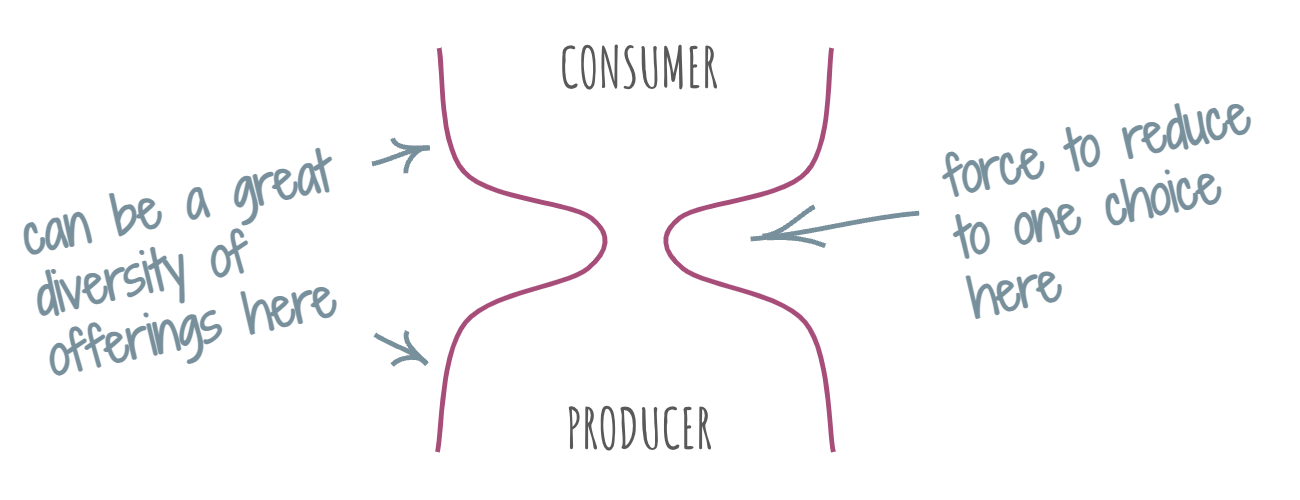
The top part of the hourglass is occupied by the recipe producers, or “frontends” in the compiler lingo. Because they all output to the same common format, there can be a great variety of these. For example, we currently have two different syntaxes for writing AI recipes in TypeScript and JavaScript. One can imagine a designer tool that allows creating AI recipes visually. 

Nothing stops someone from building a Python or Go or Kotlin or any other kind of frontend. As long as it generates the common format as its output, it’s part of the Breadboard hourglass stack.

The bottom part of the stack is where the recipe consumers live. The consumers, or “backends”, are typically runtimes: they take the recipe, expressed in the common format and run it. At this moment in Breadboard, there’s only a Javascript runtime that runs in both Node and Web environments. We hope that the number of runtimes expands. For instance, wouldn’t it be cool to load a Breadboard recipe within a colab? Or maybe run it in C++? Breadboard strives for all of these options to be feasible.

Runtimes aren’t the only kinds of backends. For instance, there may be an analysis backend, which studies the topography of the recipe and makes some judgments about its integrity or other kinds of properties. What sorts of inputs does this recipe take? What are its outputs? What are the runtime characteristics of this recipe?

Sometimes, it might be challenging to tell a backend apart from a frontend: an IDE may include both frontends (editor, compiler, etc.) and backends (runtime, debugger, etc.). However, it’s worth drawing this distinction at the system design stage.

The main benefit of an hourglass stack design is that it leaves a lot of room for experimentation and innovation at the edges of the stack, while providing enough gravitational pull to help the frontends and backends to stick together. Just like for any common language or protocol, the waist of the hourglass serves as a binding agreement between the otherwise diverse consumer and producer ideas. If this language or protocol is able to convey valuable information (which I believe we do with AI recipes in Breadboard), a network effect can emerge under the right conditions: each new producer or consumer creates combinatorial expansion of possibilities – and thus, opportunities for creating new value – within the stack.

It is far too early to tell whether we’ll be lucky enough to create these conditions for Breadboard, but I am certainly hopeful that the excitement around AI will serve as our tailwind.

The key risk for any hourglass stack is that it relies on interoperability: the idea that all consumers and producers interpret the common format in exactly the same way. Following the Hyrum’s Law, any ambiguity in the semantics of the format will eventually result in disagreements across the layers.

These disagreements are typically trailing indicators of the semantic ambiguities. By the time the bugs are identified and issues are filed, it is often too late to fix the underlying problems. Many languages committees spend eons fighting the early design mistakes of their predecessors.

As far as I know, the best way to mitigate this risk is two-fold. We must a) have enough experience in system design to notice and address semantic ambiguities early and b) have enough diversity of producers and consumers within the hourglass early in the game.

To be sure, a system design “spidey sense”, no matter how well-developed, and the ability to thoroughly exercise the stack early don’t offer 100% guarantees. Interoperability tends to be a long-term game. We can flatten the long tail of ambiguities, but we can’t entirely cut it off. Any hourglass-shaped architecture must be prepared to invest a bit of continuous effort into gardening its interoperability, slowly but surely shaving down the semantic ambiguities within the common format.

The protocol force

Here’s a riff on the “hourglass model” conversation I’ve had with Bernhard Seefeld a while back. I only recently connected it with my earlier mumblings about software layering, and here’s what came out.

If a technology stack is arranged in such a way that there are consumers of value on one end of the stack and producers of it on the other, then at a certain scale, there emerges a force that encourages one middle layer of the stack – the waist – to be as  thin as possible. There will be a distinct preference for lower diversity of offerings at that layer. IP, HTTP, and HTML are all great examples of this force’s effects.

I am going to call this force the “protocol force”, since the outcome of this force is usually a common protocol or format that is used for communicating across that layer. 

To sketch out the mechanics behind the protocol force, the upper layers want to have access to more consumers, and those are only accessible through the lower layers. The lower layers want to get more producers, and only the upper layers can provide those. To get either, the layers have to go through the waist, and they all want to minimize the cost of bridging, of implementing all the permutations that enable consumers and producers to interact with each other. Put differently, everyone wants to spend as little as possible to reach as many consumers/producers as possible.

For instance, if we have multiple interaction protocols available in the waist layer, a growth spurt of an ecosystem of producers and consumers around this layer will trigger the  “winner takes all” dynamics: a protocol that gets some critical mass of consumers (or producers) will reduce the appeal of using other protocols. As these other protocols will fall into disuse, the one that “won” will continue to gain new adopters  – thus thinning the waist layer.

Interestingly, this protocol force may not manifest in the adjacent layers, even if they look like the connectors between the upper and the lower layers. As long as there’s one layer that is thin, the adjacent layers may enjoy high diversity of offerings. 

A good example of this is the Web frameworks. There are always so many of them, right? Why is that? My explanation of this phenomenon, applying the reasoning above, is that they are protected from the effect of the protocol force by the Web Platform layer (the HTML/CSS/JS combo that we all love and enjoy) that sits right underneath them. This layer is incredibly thin: thanks to the set of circumstances and sheer designers’ luck, we only have one Web Platform.

Because of that, there can be a cornucopia of Web frameworks: as long as what they output is Web Platform-compatible, they won’t experience the pressure to agglomerate or race to the bottom.

The protocol force will be present in any layered stack that has producers and consumers as outer layers. One of the bridging layers will succumb to it. If we’re designing a layered system, we are better off preparing for this force to tap us on the shoulder and ask us to pick a layer to squish. Any resistance is futile. Might as well plan for it.

One of my favorite recent examples of such a design is the Protocol Buffers, a framework that Google uses internally to connect disparate pieces of functionality into one coherent whole. As long as a program speaks protos, it can mingle in Google-land. Whether intentionally or not, protocol buffers serve as the waist layer of Google infrastructure.

One of the key challenges of designing something as versatile as the Web Platform or protocol buffers is the fact that this layer will be the most used and, sadly. abused part of our stack. Once squished into a thin waist, this layer becomes the great enabler of our future – or the source of our doom. Its flexibility and capacity to convey the intentions of developers will be constantly tested and stretched and often broken. This is a sign of success and a good thing. As long as we’re prepared to invest into continuously improving and developing the waist of our stack, we can harness the protocol force to help us, rather than hinder.