Declarative vs. imperativethree days beforeI recently had a really fun conversation with a colleague about “declarative…
The Breadboard developer cycle
AI Patterns and Breadboard2023In my last post, I kept talking about AI patterns, but kept…
Breadboard and Opal2025Just over two years ago, I landed the first commit in a…
Hourglass model and Breadboard2024Architecturally, Breadboard aspires to have an hourglass shape to its stack. As…
Over the past couple of months, we’ve been working on a bunch of new things in the Breadboard project, mostly situated around developer ergonomics. I’ve mentioned creating AI recipes a bunch in the past, and it might be a good time to talk about the mental model of how such recipes are actually created.
❤️🔥 Hot reload
Development environment for rapid experimentation2023To set things up. I was looking for a way to enable…
One of the Breadboard project design choices we’re leaning into is the “hot reload” pattern. “Hot reload” is fairly common in the modern developer UX, and we’d like to bring it into the realm of AI recipes. In this pattern, the developer sees not just the code they write, but also results of this code running, nearly instantaneously. This creates a lightning-fast iteration cycle, enabling the developer to quickly explore multiple choices and see which ones look/work better.
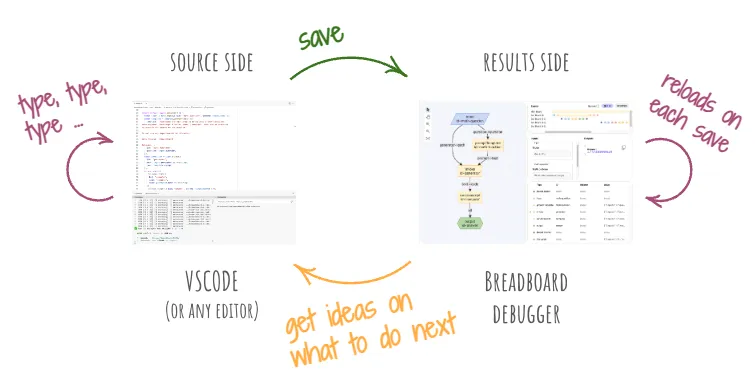
Most “hot reload” implementations call for two surfaces that are typically positioned side by side: one for writing the source code, and another for observing the results. In Breadboard today, the first one is typically an editor (I use VSCode) and the second one is our nascent Breadboard debugger.
As the name “hot reload” signifies, when I save the source code file in my editor, the debugger automatically reloads to reflect the recent changes.
Making Fifty2022This one will be a bit unusual. Instead of my typical sermons…
The typical workflow I’ve settled into with Breadboard is that I start writing the board and get it to some point where it has enough to do at least something, I save the file and play with the board in the debugger. Playing with it both informs me whether I am on the right path and gives me ideas on what to do next.
I then act on this feedback, either fixing a problem that I am seeing, or progressing forth with one of the ideas that emerged through playing.
OODA, unrolled2021Putting jank and the OODA loop next to each other, it’s hard…
The OODA Loop2021One of the lenses for which I tend to reach frequently is…
For my long-time readers: yes, we’ve baked the OODA loop right into Breadboard.
Overall, it’s a pretty fun experience. I get to see the board rising out of code by iteratively playing with it.
🪲 Debugger
To enable this fun, Paul Lewis has been doing the magician’s work bringing up the debugger. It’s very much a work in progress, though even what’s there now is already useful for board-making.
Teaching AI to write lyrics2024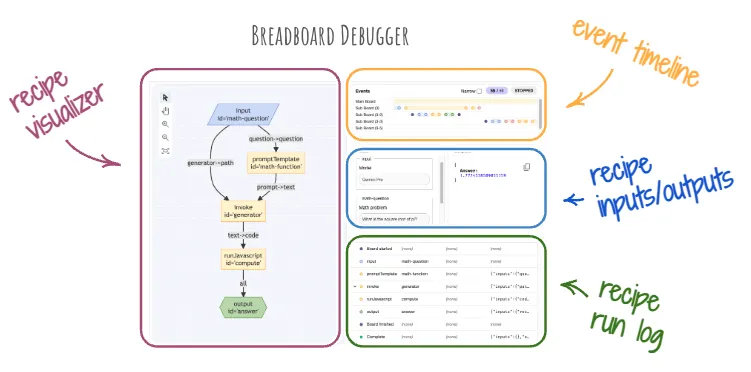

The main purpose of the debugger is to provide both the visualization of the AI recipe that is being developed and the process of it running. As I put it in chat, I love “seeing it run”: I get to see and understand what is happening during the run — as it happens! – and dig into every bit of detail.
There’s even a timeline that I can scrub through to better help me understand how events unfolded.
Placing and wiring nodes in Breadboard20231️⃣ Creating a board and adding kits to it 2️⃣ Placing nodes…
Composing graphs with Breadboard2023This post is more technical and more rambling than my usual repertoire.…
One thing that gives Breadboard its powers is that it’s built around a very flexible composition system. This means that my recipes may reach for other recipes during the run – sometimes a whole bunch of them. Reasoning about that can be rather challenging without help. As we all know, indirection is amazing until we have to spelunk the dependency chains.
To help alleviate this pain, the Breadboard debugger treats recipe invocations as the front-and-center concept in the UI. The timeline presents them as layers, similar to the layers in photo/video/sound editing tools. I can walk up and down the nested recipes or fold them away to reduce cognitive load.
There’s so much more work that we will be doing here in the coming weeks and my current description of the Breadboard debugger is likely to become obsolete very quickly. However, one thing will remain the same: the iteration speed is so fast that working with Breadboard is joyful.
🧸 Exploration through play
No ship ums2023I’ve been thinking about the path that software dandelions take toward becoming…
This leads me to the key point of what we’re trying to accomplish with the development cycle in Breadboard: exploring is fun and enjoyable when the iterations are fast and easily reversible.
This is something that is near and dear to my heart.
Diving into unpredictability2023My previous essay on the topic of unpredictability generated a few insightful…
When the stakes in exploration are high, we tend to adopt a defensive approach to exploring: we prepare, we train, and brace ourselves when it is the time to venture out into the wilderness. Every such exploration is a risky bet that must be carefully weighted, and uncertainty reduced as much as possible.
Separating cargo from the train2023I’ve been puzzling over a problem that many engineering teams face and…
When the stakes of exploration are low, we have a much more playful attitude. We poke and prod, we try this and that, we goof around. We end up going down the paths that we would have never imagined. We end up discovering things that couldn’t have been found by an anxious explorer.
Recipes for Thought2025Okay, the response is much closer, but now I see how this…
It is the second kind of exploration that I would love to unlock with Breadboard. Even when learning Breadboard itself, I want our users to have the “just try it” attitude: maybe we don’t know how this or that node or kit works. Maybe we don’t have an answer to what parameters a recipe accepts. So we just try it and see what happens – and get reasonable answers and insights with each try.
How we engage with LLMs2023When we engage with an LLM with an Opportunist Mind, we are…
Reinventing Organizations Redux14 days afterThis one is a bit out there, if only to connect some…
If you’re excited about the ideas I wrote about here, please come join us. We’re looking for enthusiastic dance partners who dream of making the exploration of AI frontiers more accessible and enjoyable.