Dandelion or Elephant?nine days beforeThe discovery of the dandelion/elephant framing was exciting and my fellow FLUX…
Convergent innovation
Dandelions and Elephants, Illustrated2023Over the holiday break, I made a thing for you to enjoy.…
r/K selection and innovation2022I’ve been thinking about the different conditions under which innovation emerges, and…
As a sort of thought appetizer, here’s a vignette attempting to intersect the divergent/convergent thinking frame and … you guessed it, dandelions and elephants.
Dandelion/Elephant Strategy Rubric2022For the environments where the shape is well-known, with no new space…
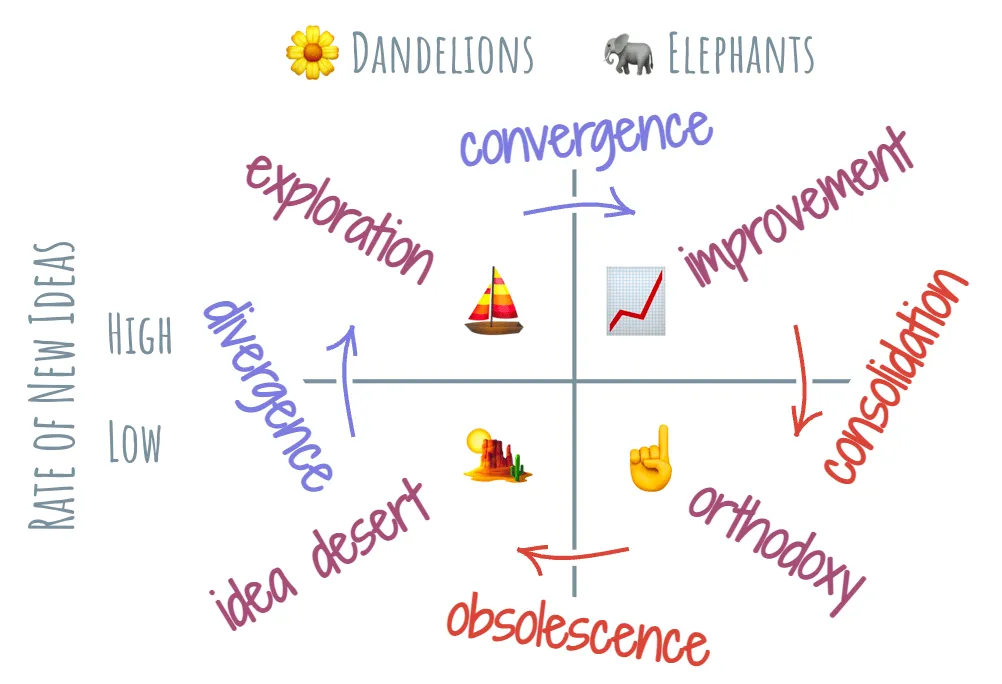
While exploring idea generation strategies, I realized that I’ve confused the opposite of divergent thinking with the lack of new ideas. That does not seem to be the case. There is a really simple 2×2 that helps illustrate that. Horizontally, we have dandelions and elephants, and vertically – the rate of new ideas that we want to encourage. Some organizations, for example, don’t want any new ideas altogether (low rate), while others have an existential need for new ideas (high rate).
Growing dandelions2022Putting these all together, we can build a simple compass. The four…
Learning from the nadir2023In the top quadrant, we are the happiest and perhaps even bored.…
The upper quadrants make sense: we have our dandelion-fueled exploration and improvements to existing ideas through the elephant strategy. The bottom-right quadrant shows up as orthodoxy – when new ideas are unwanted because we believe that there’s already one idea that is understood as well as it could be. The final, bottom-left quadrant is that of the idea desert: the absence of ideas altogether. This quadrant rarely has permanent occupants, because we humans tend to have ideas – however, we might occasionally visit it when we’re lost and disoriented.
Separating cargo from the train2023I’ve been puzzling over a problem that many engineering teams face and…
Mindset transitions and coherence2021I wonder if in the framing of organizational mindsets, there’s a pattern…
Nudges, boosts, bumpers, and tilts2023Using these two properties as axes, we can draw a nice –…
If I were to explore how an organization might move from quadrant to quadrant, there appear to be four clockwise motions, from one quadrant to another. When our process of ⛵exploration (the top-left quadrant) yields many interesting ideas, organizations tend to shift into the convergent posture: start looking for one idea that will become bigger than others. A typical call here is “more wood behind fewer arrows” and conversations about prioritization and hard decisions. Convergence leads to the top-right quadrant of 📈 improvements, where most of our efforts are invested into reinforcing the idea.
Performance Management Blindspot2021Reflecting on the recent Google’s perf season, I came up with a…
How to make a breakthrough2022The title is a bit tongue-in-cheek, because I am not actually providing…
Thinking in this quadrant does not need to be boring and uncreative. For example, one of my colleagues, upon joining our team, spent a bunch of time looking through the code and spotted a bug: in handling mouse events, we would sometimes hit an O(n2) condition – and that was unnecessary. Their first commit to the codebase was a performance breakthrough. When I think of innovation in the top-right quadrant, I keep recalling that bit of code. It was clearly a novel insight, yet it also demonstrably improved the state of the bigger idea.
The law of tightening aperture2023What happens to the teams with wide apertures over time? Does the…
Unfortunately, our residence in this quadrant usually comes to an end due to the consolidation move. In an effort to better protect the value contained within the big idea, organizations usually shift to the quadrant of ☝️orthodoxy, where any new ideas are viewed as mostly distractions. There’s so much stuff to do already! The problem lists are long and the issues are well-known. Let’s just keep on fixing them, shall we?
Steady winds, doldrums, and hurricanes2023Prior to the invention of motors, doldrums were a terrifying thing for…
As you may suspect from the flow of this story, the discouraging of new ideas eventually triggers the next move: obsolescence. This move puts us into the 🏜 idea desert. We know that the old big idea no longer works, but we have nothing else to hang onto. The discomfort of this quadrant acts a powerful motivator, manifesting as the divergence move that propels us back into the ⛵exploration quadrant. This move might coincide with the demise of the organization, when the divergence acts as a pulling-apart force of ideas, each stakeholder pursuing their own.
Growth and control biases2023When we don’t recognize that growth and control are in tension with…
If we are to believe this tall tale, we can see that divergence and convergence are somewhat orthogonal moves. The divergence is mostly about moving from zero to many ideas while relying on dandelion strategies.
Short-term divergent, long-term convergent2022A conversation with colleagues brought this insight to the surface. We were…
On the other hand, the convergence is a qualitative shift. It does not change how much idea-generation we do, but rather whether or not these ideas are independent from each other. A productive convergence is the one where people ideate while building on each other’s ideas, improving upon one unifying big idea – the elephant strategy.
Framing and solving diverge-converge exercises2021There’s this fairly common technique: the diverge-converge exercise. I first heard about…
This might not be news to you at all, but this was a pretty useful insight for me. When planning the next diverge/converge exercise:
- Rubber duck meetings2022
When I am looking for new insights, a generative conversation with colleagues…
To get divergence truly going, put people in the idea desert. Let them have the sense that all of their previous, strongly-held beliefs might not be as sound and safe as they seem. This might mean not letting people prepare for the exercise or even creating an idea parking lot that is filled at the beginning with the ideas that we already have. - Recognize the creative part of convergent thinking. Let people continue ideate, but shift the constraints of the exercise to encourage the clumping of ideas together. Avoid prematurely collapsing the process straight toward the orthodoxy.
Cutting or highlighting?2021Talking with one of my wise colleagues, we arrived at this neat…
Generating ideas and strategy coherencethe same dayI’ve been talking about dandelions and elephants for a while now, and…
Convergence doesn’t have to be a boring prioritize-and-cut procedure. It can be fun – and who knows, maybe produce new ideas that didn’t pop up during the divergence part of the exercise?