e-LOCthree days beforeI’d like to introduce a metric for developer APIs that I call…
r/K selection and innovation
I’ve been thinking about the different conditions under which innovation emerges, and how the environment influences the kind of innovation that happens.
Growth and control biases2023When we don’t recognize that growth and control are in tension with…
To set the stage, I am going to do a very brief detour into biology (I am not a biologist, so will definitely make a mess of it) and use the r/K-selection lens to guide this story. If we observe various organisms, the theory goes that all fall somewhere in the spectrum between r-selection and K-selection. The r-selection is a strategy that’s focused on reproduction: make copies of my kind as quickly as possible, and mutate generation to generation. The K-selection is a carrying capacity strategy: stay alive as long as possible, learn and teach my (usually very few) offsprings the necessary tricks to thrive. Both are viable strategies, depending on the environment.
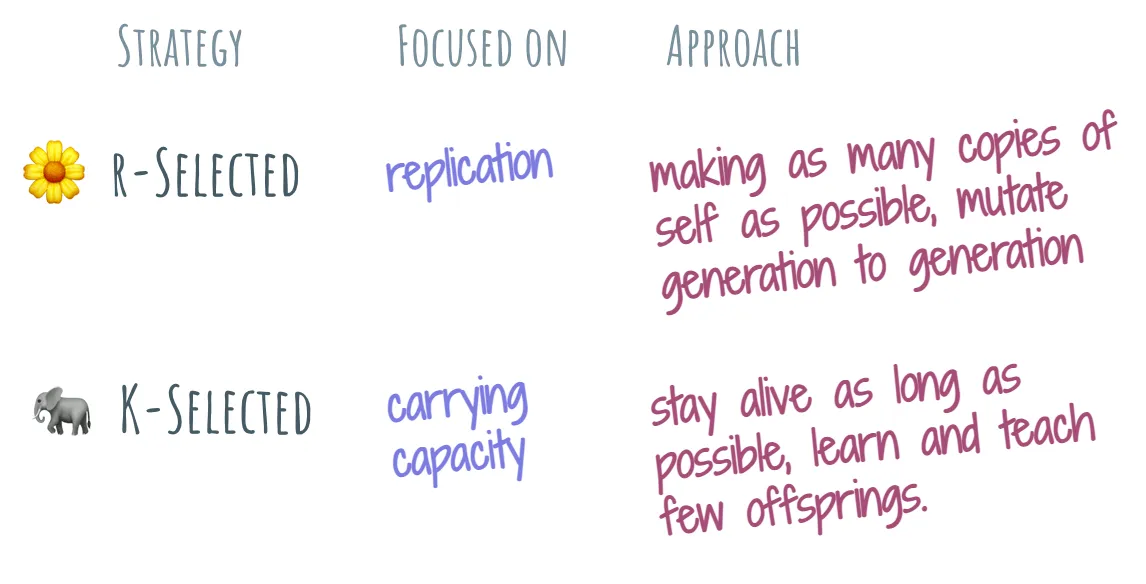
Typical examples used for r-selection are dandelions and for K-selection – elephants. To bring it closer to home, we can have the coronavirus represent the side of the r-selection, and us humans the K-selection. The battle of pandemic/endemic we’re still locked in shows that humans are likely to win, but oh boy is COVID giving us the run for the money.
Turning to the realm of ideas, it seems that some of them are r-selected. In the most basic form, ideas are memes: easily transmitted, rapidly spreading earworms. Each transmission is an opportunity for mutation. As they inhabit our mind, ideas fall in the fertile ground of other ideas and the next time we communicate these ideas, we – nearly always – change them. They mutate into something different. As the r-selected strategy suggests, ideas evolve as they are copied.
Say it in many different ways2021Shared mental model spaces are challenging to grow and expand. Mental models,…
Other kinds of ideas are K-selected. These are usually larger, self-coherent entanglements of smaller ideas. They live in our minds and they evolve over time, growing and maturing. Just like K-selected organisms, these ideas reproduce with pain and effort. We can’t just give them to others. We must garner our patience and engage with them in the process of teaching, smuggling them across the often unreliable medium of interpersonal communication, one tiny elemental bit at a time.
Moving the ladder2022Riffing on the cost of opinion piece, I realized that there’s a…
Pace layers of predictability2023One thing that stood out to me was this notion of a…
The waterline2023This one is a very short framing, but hopefully, it’s still useful.…
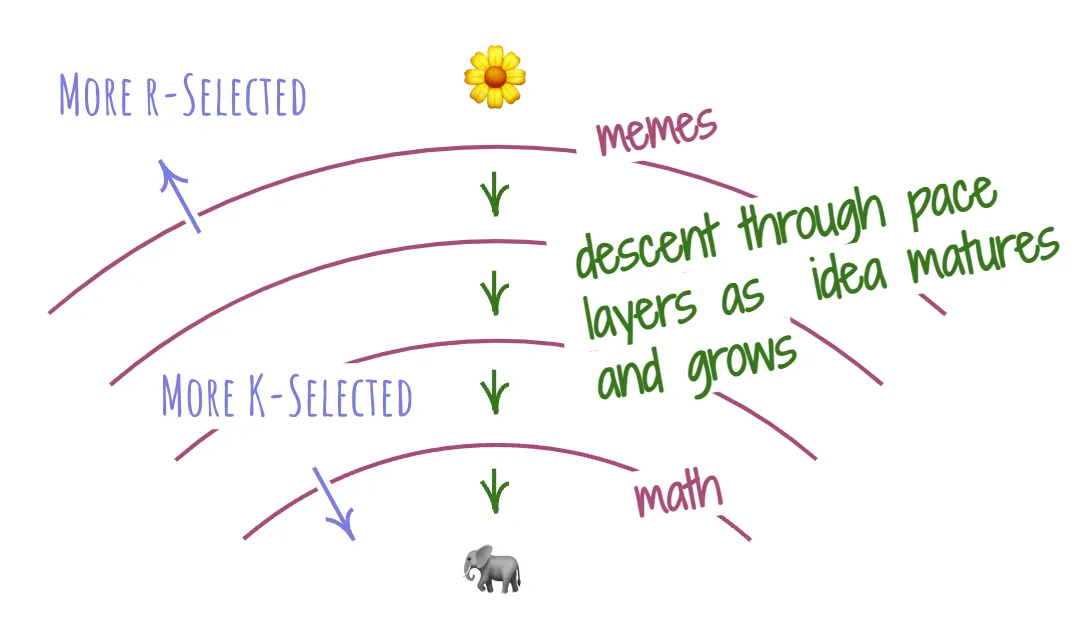
My fellow FLUX-er Erika pointed out that by putting these two strategies into a spectrum, a framing of pace layers pops out. There are simple ideas boiling afroth at the top layer in a pure r-selected strategy. As they connect with other ideas, their strategy becomes more and more K-selection-like, forming layers that move at a slower pace. Learning Newtonian physics? Welcome to the lower layers. Reading the latest memes on Twitter? That’s at the top.
Cheesecake and Baklava2022To compare and contrast, let’s look at Cascading Style Sheets. It’s fairly…
This pace layering offers us a neat way to look at the kinds of innovation. Since innovation is powered by ideas, we can see it manifest in different ways at different pace layers. The higher, more r-selected layers are great for rapidly exploring new spaces, where there are lots of unknowns and possibilities. The lower, more K-selected layers are incredibly effective for optimizing and refining existing ideas. As ideas mature, they traverse the pace layers, descending from r to K.
Dandelion or Elephant?2022The discovery of the dandelion/elephant framing was exciting and my fellow FLUX…
Using this lens, an organization that desires to innovate can act more intentionally by picking the idea selection strategy. If we’re looking at a new wide-open space, or searching for the next frontier, we would want to create conditions where ideas can spread rapidly and replicate to mutate.
A recent example of this happening is the release of Stable Diffusion, an AI model for generating images from prompts. Simon Willison has an insightful write-up of the phenomenon, and we don’t have to squint to spot application of the r-selected strategy: the model and the surrounding tools are open source, and the process of setting up your own instance is fairly straightforward.
Combined with rising interest around the future potential of generative media, this caused an immediate explosion of innovation: people messing with it for fun and/or quickly putting together possible business ideas. Given that no other contenders offered such an opportunity to the interested crowd, I would not at all be surprised if Stable Diffusion, no matter how well it fares in its comparative quality today, becomes the de-facto engine for generating pictures from text.
Recipes for Thought2025An expert in organizational strategy will undoubtedly have a wealth of cognitive…
On the other hand, if we want to climb the gradient hill and improve upon an existing idea, we are better off picking the K-selected strategy: invest into apprenticeship practices to facilitate tacit knowledge transfer, and ensure that idea refinements are carefully curated.
Four layers2023An illustration for how this plays out is the abundance of the…
I will once again lean onto browser development to illustrate the K-selected strategy. The modern Web rendering engine, which is the thing that interprets text, images, and code as a visual, interactive composition on your screen that we call “Web sites” is a prototypical outcome of descending down the pace layers.
No ship ums2023I’ve been thinking about the path that software dandelions take toward becoming…
A wild-haired idea at first, it eventually grew into a massively complicated and often self-contradictory tangle of ideas that is captured in code. There are only three distinct instances of that code: WebKit, Blink, and Gecko. These instances try to interoperate, and there is an incredible amount of knowledge — both tacit and described in long, dry documents called specs – that need to be grokked before proceeding with constructing another instance. If Stable Diffusion is a dandelion, Web rendering engines are elephants.
Stages of project forking2023To give you an example of this progression, here’s an abbreviated (and…
One does not simply create a new rendering engine. To move forward, a K-selected strategy is called for. When we look at the efforts surrounding creating a rendering engine, we can see extensive documentation and education that helps aspiring Web browser engineers climb the learning curve, as well as rigorous processes to ensure that every change that is being made to the codebase carefully, yet purposefully evolves the project.
Innovation frontier2023First, we need to know what our embodied strategy is. We need…
Separating cargo from the train2023I’ve been puzzling over a problem that many engineering teams face and…
Embodied Strategy2022I was having a great conversation with a colleague about organizational learning…
The Perspective Ladderthree days afterI’ve been trying to come up with a better way to illustrate…
Growing dandelionslinks here, 2022A couple of weeks ago, I talked about r/K-selection and mentioned two…
Caring for elephantslinks here, 2022My intuition here is that elephants are rarely created from whole cloth.…
Shadows and Curseslinks here, 2022The particular kind of curse I want to highlight here emerges from…
Convergent innovationlinks here, 2022As a sort of thought appetizer, here’s a vignette attempting to intersect…
Generating ideas and strategy coherencelinks here, 2022I’ve been talking about dandelions and elephants for a while now, and…
Dandelion/Elephant Strategy Rubriclinks here, 2022I already used the AI-generated media space as the currently-unfolding example of…
Similarly, we can anticipate mismatches in the kind of innovation we’d like to see and the strategy that we have at our disposal. We can’t expect to explore a new space with data-driven analyses and an elite team of experts — just like we can’t expect to see consistent results aimed toward some goal if we’re set up for rapid, unbridled experimentation.
Show 5 comments
Growing dandelion APIs – Dimitri Glazkov linked here · October 6, 2022
[…] couple of weeks ago, I talked about r/K-selection and mentioned two kinds of ideas: the mutate-through-replication dandelions and capacity-preserving […]
Caring for elephants – Dimitri Glazkov linked here · October 13, 2022
[…] a rare dandelion-idea that managed to grow and accrue value over a long period of time, traversing the idea pace layers. So, we rarely choose to be in the position of elephant caregiver: it’s something that happens to […]
Convergent innovation – Dimitri Glazkov linked here · November 2, 2022
[…] As a sort of thought appetizer, here’s a vignette attempting to intersect the divergent/convergent thinking frame and … you guessed it, dandelions and elephants. […]
Generating ideas and strategy coherence – Dimitri Glazkov linked here · November 2, 2022
[…] it’s such a good framing and I keep finding uses for it nearly every day. When applied to ideas, r/K-selection strategies seem to be uncommonly […]
Shadows and Curses – Dimitri Glazkov linked here · November 14, 2022
[…] here emerges from a seemingly innocent concept of idea pace layers. I touched on it briefly in my first article about dandelions and elephants. Ideas thrive as light, free-floating dandelions. Some survive the […]