Adult Development PrimerDecember 2020Over Thanksgiving break, I wrote another one of those flip-through decks. It’s…
The Relationship Polarity
The tension between Agency and Belonging2020In the Four Needs framework, I identified a tension between two opposing…
The System of Self2019Here’s a checkpoint for Archeology of Self, a marker of where I’ve…
Puzzle Me2019Where do I end? Where does the “outside of me” begin? These…
I’ve been feeling a little stuck in my progress with the Four Needs Framework, and one thing I am trying now is reframing my assumptions about the very basics of the framework. Here’s one such exploration. It comes from the recent thinking I’ve done around boundaries and relationships, a sort of continuation of the Puzzle Me metaphor. In part, the insight here comes from ideas in César Hidalgo’s Why Information Grows and Lisa Feldman Barrett’s How Emotions Are Made.
The Illusion of Injured Identity2019Throughout my live, I accumulate identities: a father, a husband, a software…
My conscious experience is akin to navigating a dense, messy network of concepts. I construct reality by creating and organizing these concepts. One way in which I organize concepts is by defining relationships between them and me. The nature of the relationship can be viewed as a continuum of judgements I can make about whether a concept is me or not me. For concepts that are closer to “me” in this continuum, I see my relationship with them more like a connection.
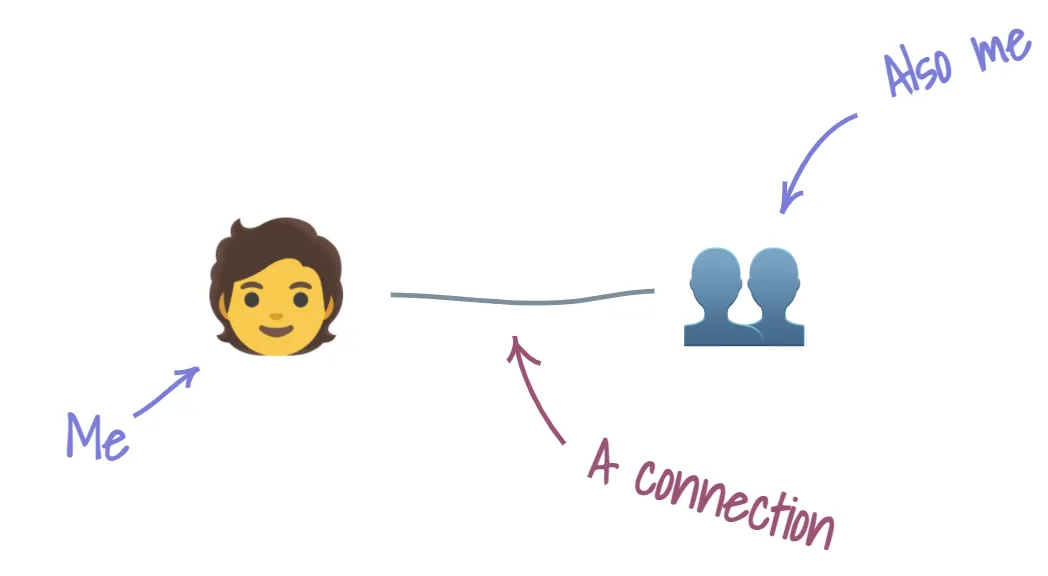
For concepts that are closer to “not me,” I judge the relationship with them as more like a boundary.
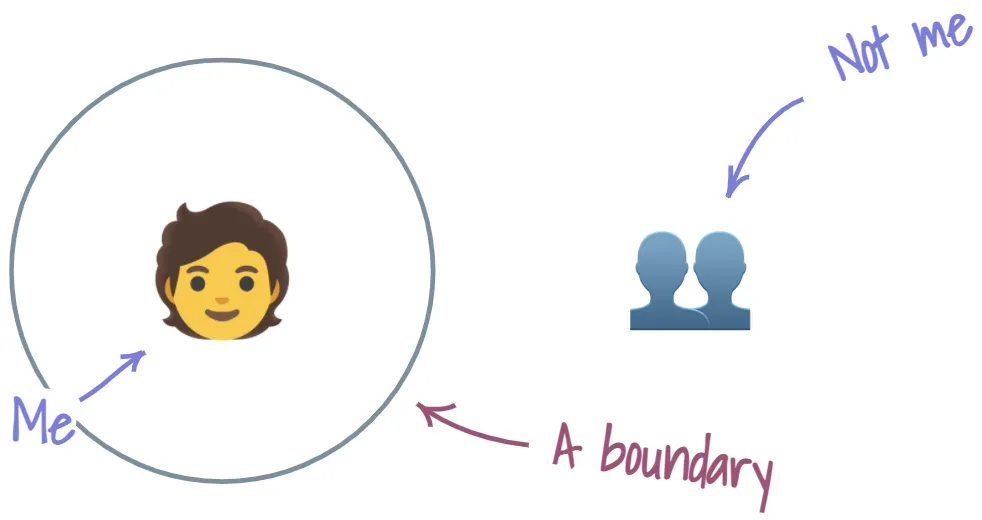
Sometimes the choice is clearly “me”, like my Self. Sometimes it’s nearly perfectly “me”, like my nose. Sometimes the choice is clearly not me. For example, last time I touched a hot stove I suddenly became informed that it definitely was not me. Sometimes, the position is somewhere in the middle. My bike is not me, since it’s not actually my body part, but it can feel like an extension of me on a Sunday ride.
Think of this continuum of judgements as a continuum between boundary and connection. The more I feel that the concept is “me,” the closer it is to the “connection” end of the continuum. The more I feel that the concept is “not me,” the farther it sits toward the “boundary” end of the continuum.
Tension in Shared Mental Model Space2022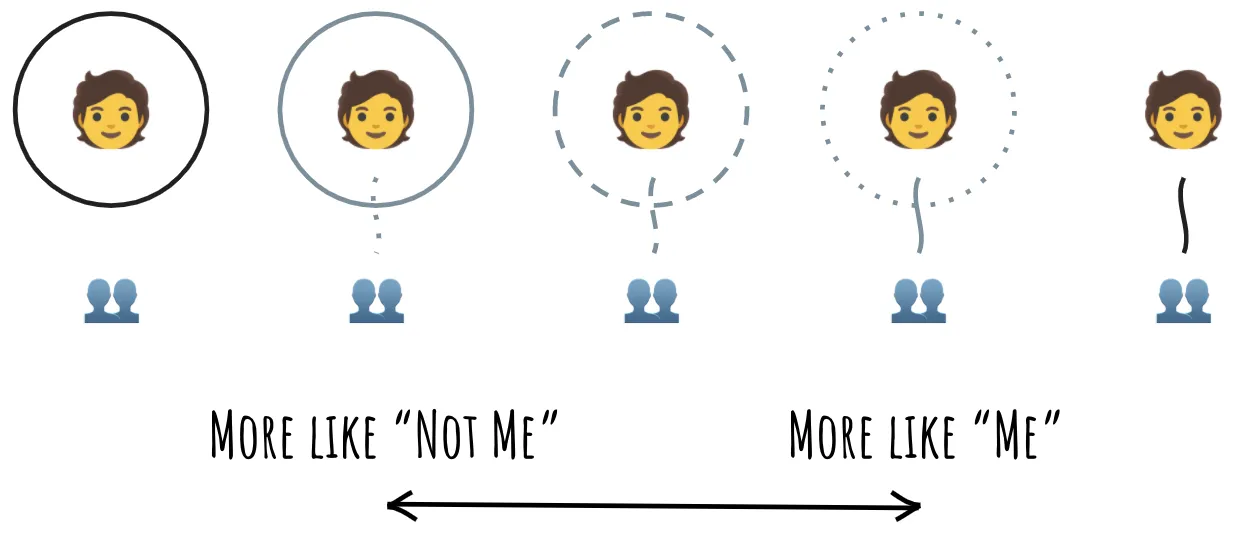

The Perspective Ladder2022Another rung up is “holding a perspective”. My attachment to the perspective…
In this framing, the choices I make about my relationship with concepts are points on this continuum. As I interact with concepts, I define my relationship with them by picking the spot on this continuum based on my interaction experiences.
This is where the next turn in this story comes. It seems that some concepts will naturally settle down into one spot and stay there. “Hot stove” will stick far toward the “boundary” end of the continuum. “My bike” will be closer to “connection.” On the other hand, some concepts will resist this simple categorization. Depending on the interaction experience, they might appear as one of several points on the continuum. They might appear as a range, or maybe even a fuzzy cloud that covers part or the entire continuum.
How to think and what to think2023We act on what we think, so “what to think” is close…
The concepts that settle down into steady spots become part of my environment: they represent things that I assume to be there. They are my reference points. Things like ground, gravity, water, and so on take very little effort to acknowledge and rely on, because our brains evolved to operate on these concepts exceptionally efficiently.
Understanding2022Once the notion of a problem is sufficiently semantically disambiguated, we can…
The concepts whose position on the continuum is less settled are more expensive to the human brain to interact with. Because our brains are predictive devices, they will struggle to make accurate predictions. By expending extra energy, our brains will attempt to “make sense” of these concepts. A successful outcome of this sense-making process is the emergence of new concepts. Using the hot stove example from above, the brain might split the seemingly-binary concept of a “stove that sometimes hurts and sometimes doesn’t” into “hot stove” and “cold stove.” This new conceptual model is more subtle and allows for better prediction. It is also interesting to note how concept-splitting retains transitive relationships (“hot stove” is still a “stove”) and seems to form a relational network for stable concepts.
The third option2024The deeper insight here is that we are surrounded by polarities. Behind…
There’s also a possibility of a stalemate in this seemingly mechanical game of concept-splitting: a relationship polarity. A relationship polarity occurs when the concept appears to resist being split into a connected network of more stable concepts.
Mental models2022I use the term “mental models” a lot, and so I figured…
Somatic Signals: How I use the Four Needs Framework2020This post marks a second anniversary of my self-work journey. Wow. 2020…
Transformational Learning2020Building on the ideas in The Suffering of Expectations, I want to…
Sometimes I feel cranky, and sometimes I feel happy. Is it because I am hungry? Sometimes. Is it because of the weather? Sometimes. Relationship polarities are even more energy-consuming, because they produce this continuous churn within the relational network of concepts. My mind creates a model using one set of concepts, then the new experiences disconfirm it, the mind breaks it down, and creates another model, and so on. There’s something here around affect as well: this churn will likely feel uncomfortable as the interoceptive network issues warnings about energy depletion. In terms of emotions, this might manifest as concepts of “dread”, “stress”, “anxiety”, etc.
Touching infinity2022As we explore the process of understanding, it may not be immediately…
The Upper Limit Of Understanding2019Walking down the yellow-brick road of everything being storytelling, I stumbled into…
Change2022If you’ve read my stories before, you may recognize the familiar stair-step…
What the heck is 3P?40 days afterI hear folks using the terms “3P,” “1P,” and even “2P” or…
Tracing the boundarylinks here, 2022I’ve been grappling with squaring this circle ever since, fairly unsuccessfully. One…
What was most curious for me is how a relationship polarity arises naturally as a result of two parties interacting. The key insight here is in adaptation being a source of the seeming resistance. As both you and I attempt to construct conceptual models of each other, we adjust our future interactions according to our models. In doing so, we create more opportunities for disconfirming experiences to arise, spurring the concept churn. The two adaptive parties do not necessarily need to be distinct individuals. As I learn more about myself, I change how I model myself, and in doing so, change how I learn about myself.
Show 1 comment
Tracing the boundary – Dimitri Glazkov linked here · January 28, 2022
[…] circle ever since, fairly unsuccessfully. One direction that seemed promising was the framing of boundaries and “tracing the boundary” thought experiment. Here is how it […]