Receiving negative feedbacksix days beforeNegative feedback is rarely fun, but can show up in varying degrees…
Nudges, boosts, bumpers, and tilts
A motor and a rudder2021Having done a bit of work on researching and sketching out strategies…
Nudging Embodied Strategy2022The whole concept of the cone of embodied strategy is a bit…
Bumpers, Boosts, and Tilts2022A discussion late last year about different ways to influence organizations led…
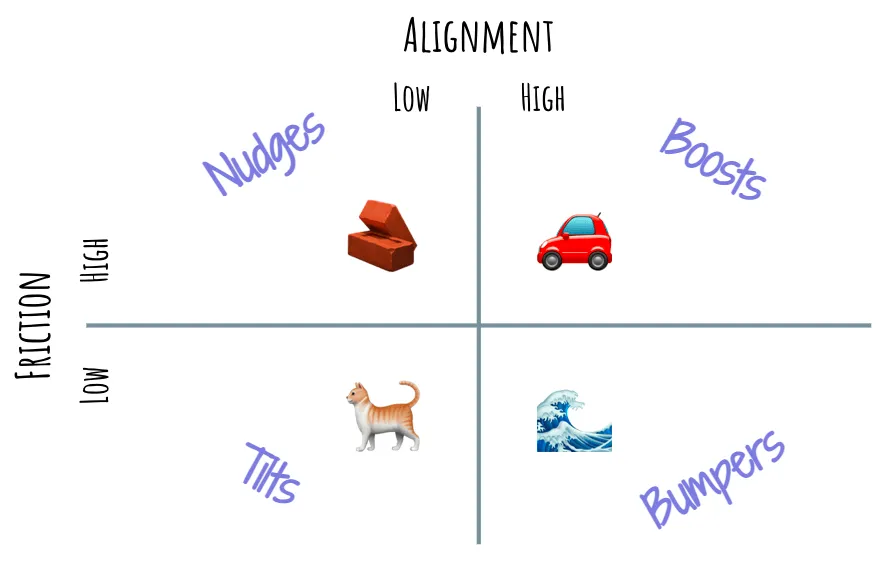
The quartet is finally complete. I’ve written about nudges separately, and already had bumpers, boosts, and tilts grouped. Now they are all united into one simple framework that helps me better understand the environment in which I am operating and reason about imparting change on this environment.
To better understand an environment, we evaluate two of its properties: degree of inter-part alignment and degree of inter-part friction.
Jankless2021As we Orient, examining our prediction error and updating our model of…
The inter-part alignment tells us how much the parts are aligned with each other. The inter-part alignment is not a static property, but rather an evaluation of how much the various moving parts of the environment choose to act. Since I mostly work with teams, these parts are typically people. The inter-part alignment is our guess at how much the people within the team are aligned along similar goals and objectives.
Organizing and sensing connections2021Tucked away in a couple of paragraphs of the brilliant paper by…
The inter-part friction tells us how much attachment the parts have to each other. If they are strongly attached, there’s a lot of friction between them. If they aren’t, there’s nearly none. Highly interdependent environments are usually the high-friction ones. In organizations, this friction is experienced as the degree to which people feel constrained by other people in their actions.
Convergent innovation2022As a sort of thought appetizer, here’s a vignette attempting to intersect…
Using these two properties as axes, we can draw a nice – what else? – two-by-two. For each quadrant in this space, there’s a technique that, when applied, is most likely to result in desired outcome. Let’s walk around the quadrants, clockwise, starting from top-right.
Enumerating constraints2021From the bottom, we are supported — and limited — by our…
One thing to remember: teams are almost never easily assessed as exemplars of one particular environment. They flex and shift, changing from one kind to another. Environments are also scenario-specific. The same team might look like one environment for a particular problem, and a completely different environment for another problem.
🚗 High alignment, high friction
A problem2022To get a more solid grounding of the newly born decision-making framework,…
In the top-right quadrant of two-by-two reside the high alignment and high inter-part friction environments. A good metaphor for this environment is a car that’s stuck in a ditch. It wants to go, but does not have the power to overcome the friction of the ditch.
Organizational pathology2022The “Royalfield” case study, one of many in Rumelt’s book, particularly stood…
For an organization, this might be the scenario where everyone agrees on the importance of the problem and there’s agreement on the solution, but the mustering of the actual resources to do the work is an issue.
Cutting or highlighting?2021Talking with one of my wise colleagues, we arrived at this neat…
This is where a boost is the most effective technique. Everyone lends their shoulder and leans in to get the car out of the ditch. Boosts are fairly straightforward, since they are a prioritization exercise. Just decide what is most important and go for it.
🌊 High alignment, low friction
A strategy and a plan2021Working as a group, our good fortune depends (among other things) on…
In the bottom-right quadrant, we find environments that have high alignment and low inter-part friction. These will feel like water: parts move freely, but also simply seek static equilibrium. These are the “just tell me what to do” scenarios.
Decision-making mindsets2023I have this intuition that the process is not the most important…
A good example of this scenario is an organization that needs direction on some specific issue that is widely recognized as existentially critical, but does not have strong opinions on the solution.
In my experience, these situations are rare and I usually see them in the realm of complex policy decisions that an organization needs to make, with only a handful of recognized experts who actually know how to make them.
The technique to use in high-alignment, low-friction situations is a bumper. Just draw the line not to be crossed, clearly articulate the consequences of crossing it, and firmly enforce it. Just like water is content to be in a glass, high-alignment, low-friction environments will be happy to abide by our bumpers.
🐈 Low alignment, low friction
Dandelion/Elephant Strategy Rubric2022For the environments where the shape is well-known, with no new space…
The fractal dragon2021I’ve already shared this piece elsewhere, but might as well post it…
Moving on to the bottom-left quadrant, there are environments with low alignment and low friction. These are the “herding cats” environments. There is literally nothing one can do through direct influence – no matter what we try, the energy from our actions seems to be rapidly absorbed into the whole without any discernible change. I wrote a little essay called “The Fractal Dragon” to describe this environment using a more dramatic metaphor.
Pace layers of predictability2023One thing that stood out to me was this notion of a…
In organizations, low-alignment, low-friction environments are typically full of smart, yet self-interested people. If we’re very technical about these teams, they are not technically teams, but rather markets. Open source projects and standards bodies can be good examples, though I’ve seen actual engineering teams that have similar structures. A good marker here is a loose relationship between funding and fitness function.
Gravity and water2023I have been lucky enough to be part of the process of…
The structure of a tilt2022While I roughly understand how boosts and bumpers work, and I’ve seen/made…
In a low-alignment, low-friction scenario, the go-to technique is tilts. Changes can only be made by carefully crafting incentives to tilt in the direction that we want and be patient with the organization eventually following the slope of the tilt. Despite the temptation to “do something”, it is important to recognize that any attempt at direct action is likely a waste of energy – or worse, an introduction for further chaos into the environment, with all of the unintended consequences that follow.
An effectively executed tilt has a nice positive side effect: it acts as an alignment function. When it’s working, the slope of the tilt also aligns the environment. Everything is roughly moving in the same direction.
🧱 Low alignment, high friction
Mindset transitions and coherence2021I wonder if in the framing of organizational mindsets, there’s a pattern…
In the remaining top-right quadrant, we have environments that have low alignment and high friction. A good example of such an environment is an organization that is stuck in a dynamic equilibrium: parts of it (be that individuals or teams) are deadlocked, none willing to budge. A significant amount of energy is expended on all sides, yet there is no progress. This can happen for multiple reasons. One team might have strong incentives to not let go of a project. Another team might be firefighting, unable to spare any attention to unblock others. Yet another team could have strong, uncompromising opinions about the way things need to be done.
Embodied Strategy2022I was having a great conversation with a colleague about organizational learning…
In such a situation, the appropriate technique is nudging: looking for key leverage points that are most susceptible to change. These are typically going to be found in critical juncture points that don’t have a single party to resolve them. I have done a bunch of nudging like this. Sometimes a single meeting is enough to move things along. Or as I described in “Nudging Embodied Strategy”, setting up a chat room.
Why will this be hard for us?2021I was working on a strategy and helping review another this week,…
The waterline2023This one is a very short framing, but hopefully, it’s still useful.…
Low-alignment, high-friction environments can be rather frustrating to work with. It may take several nudges – and a lot of trial and error – to make a change that would have been effortless in any other environment. Keen observation of the overall environment and spotting the leverage points is the key here. Come equipped with a lot of patience and time.
🧭 Yet another compass
Learning from the nadir2023In the top quadrant, we are the happiest and perhaps even bored.…
At least the way I see it, for each of the quadrants, there seems to be a fairly clear match of a technique. Mismatching technique to the quadrant tends to lead to unproductive outcomes.
For instance, when we find our bumper technique being ineffective, we might have confused our quadrants. In this case, we’re likely in a low-alignment, low-friction scenario where a tilt will be much more effective. This is a common error in designing processes. Folks assume that they are in the bottom-right quadrant and devise a clear policy, only to see the team find ways to dull the policy with workarounds and generally make a mockery of it. Bumpers only work when there’s high alignment.
Vision-oriented and impact-oriented mindsets2022Impact-minded folks tend to fall into the trap of opportunism. When I…
Behavior over time graphs and ways to influence2022I was geeking out over behavior-over-time graphs (BOTG) this week and found…
Similarly, if we find that our boosting and prioritization is ineffective or has at best temporary effects, we might be experiencing another instance of quadrant confusion. We are likely in a low-alignment, high-friction environment. The problem with our car is not that it’s in a ditch. It’s that it isn’t sure it wants to leave it. I wrote about my personal experience with such a confusion in “Behavior over time graphs and ways to influence”.
The OODA Loop2021One of the lenses for which I tend to reach frequently is…
This matching (and mismatching) works both ways. The effectiveness of techniques tells us about the nature of the environment we’re working with – and can help us better understand it. If we start with a tilt, predicting a low-alignment, low-friction environment, and see little evidence of the tilt working, we might reconsider – perhaps the friction is not as high as we thought it was? Or maybe the alignment is higher than we surmised? By guessing the quadrant and applying the technique, we get more information about the environment we’re operating in, giving us insights for future actions.
The Four Needs Framework2020The stories we tell ourselves shape how we see the world around…
Sailors and Piratesseven days afterHere’s a fun metaphor for you. I’ve been chatting with colleagues about…
In this way, this little framework of mine might be used as a navigation tool for us inspired process engineers. Give it a try and tell me how it works for you.