Micro and macro jankthe same dayIf our team’s OODA loop runs just a tiny bit slower than…
Retained and immediate mode
The OODA Loop2021One of the lenses for which I tend to reach frequently is…
The ODA and OODA stances2023The OODA stance discards the idea of perceiving the environment directly. Instead,…
At the core of the OODA loop is the concept of a model. To create space for exploring it in depth, we’ll make a tiny little digression back into — you guessed it! — graphics rendering technology.
With my apologies to my colleagues — who will undoubtedly make fun of me for such an incredibly simplified story — everything you see on digital screens comes from one of the two modes of rendering: the immediate or the retained modes.
Jank2021I first learned about jank when I joined the Chrome team. It’s…
The immediate mode is the least complicated of the two. In this mode, the entirety of the screen is rendered from scratch every time. Every animation frame (remember those from the jank chapter?) is produced anew. Every pixel of output is brand new for each frame.
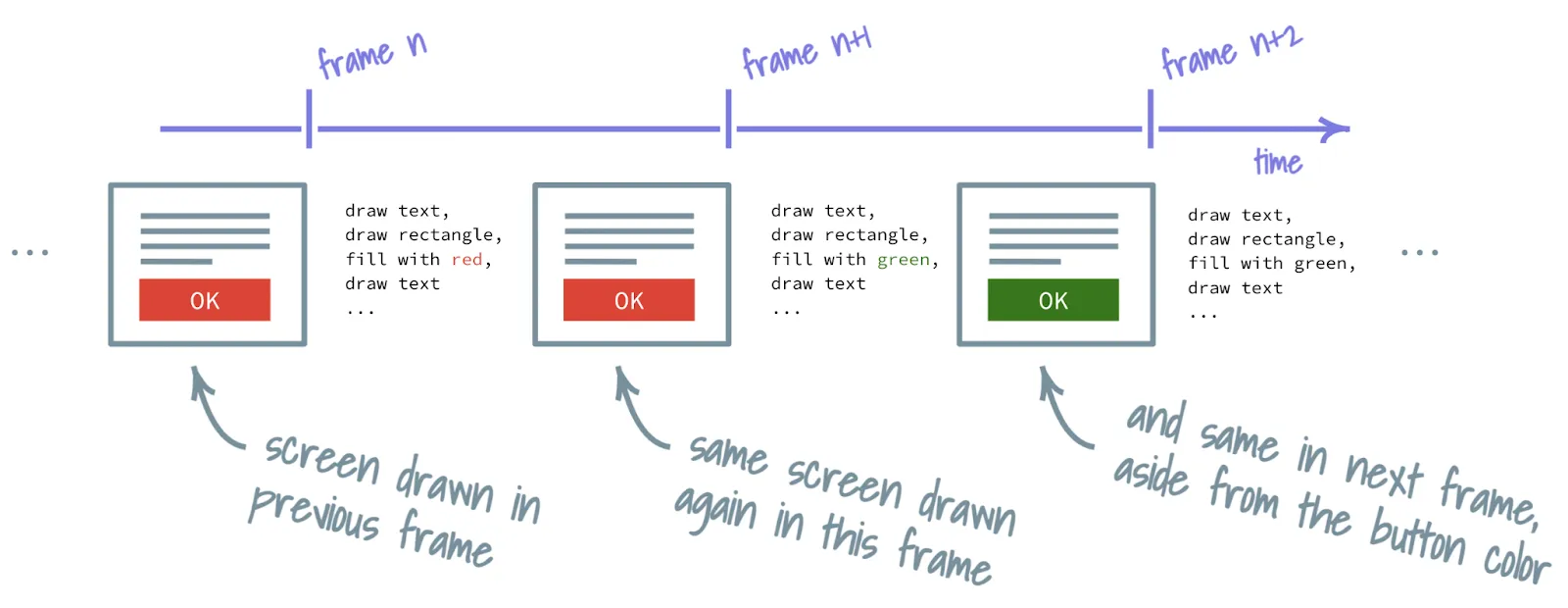
You might say: yeah, that seems okay — what other way could there be? Turns out, the immediate mode can be fairly expensive. “Every pixel” ends up being a lot of pixels and it’s hard to keep track of them, yet alone orchestrate them into user interfaces. Besides, many pixels on the screen stay the same from frame to frame. So clever engineers came up with a different mode.
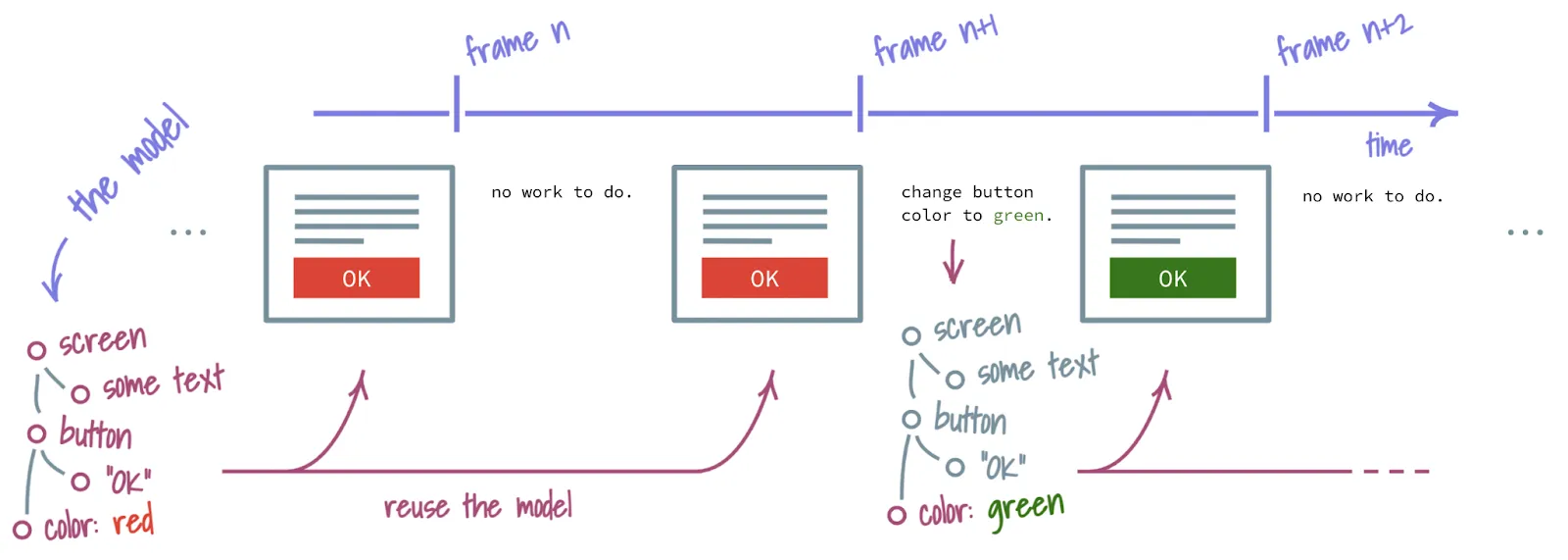
In retained mode, there exists a separate model of what should be presented on screen. This model is usually an abstraction (a data structure as engineers might call it) that’s easy to examine and tweak and it is retained over multiple frames (hence the “retained” in the name). Such setup allows for partial changes: find and update only the parts of the model that need to change and leave the rest the same. So, when we want a button to turn a different color, the only part that has to be changed is the one representing the button’s color.
Prediction errors and jank2021It seems that the retained mode is our way to compensate for…
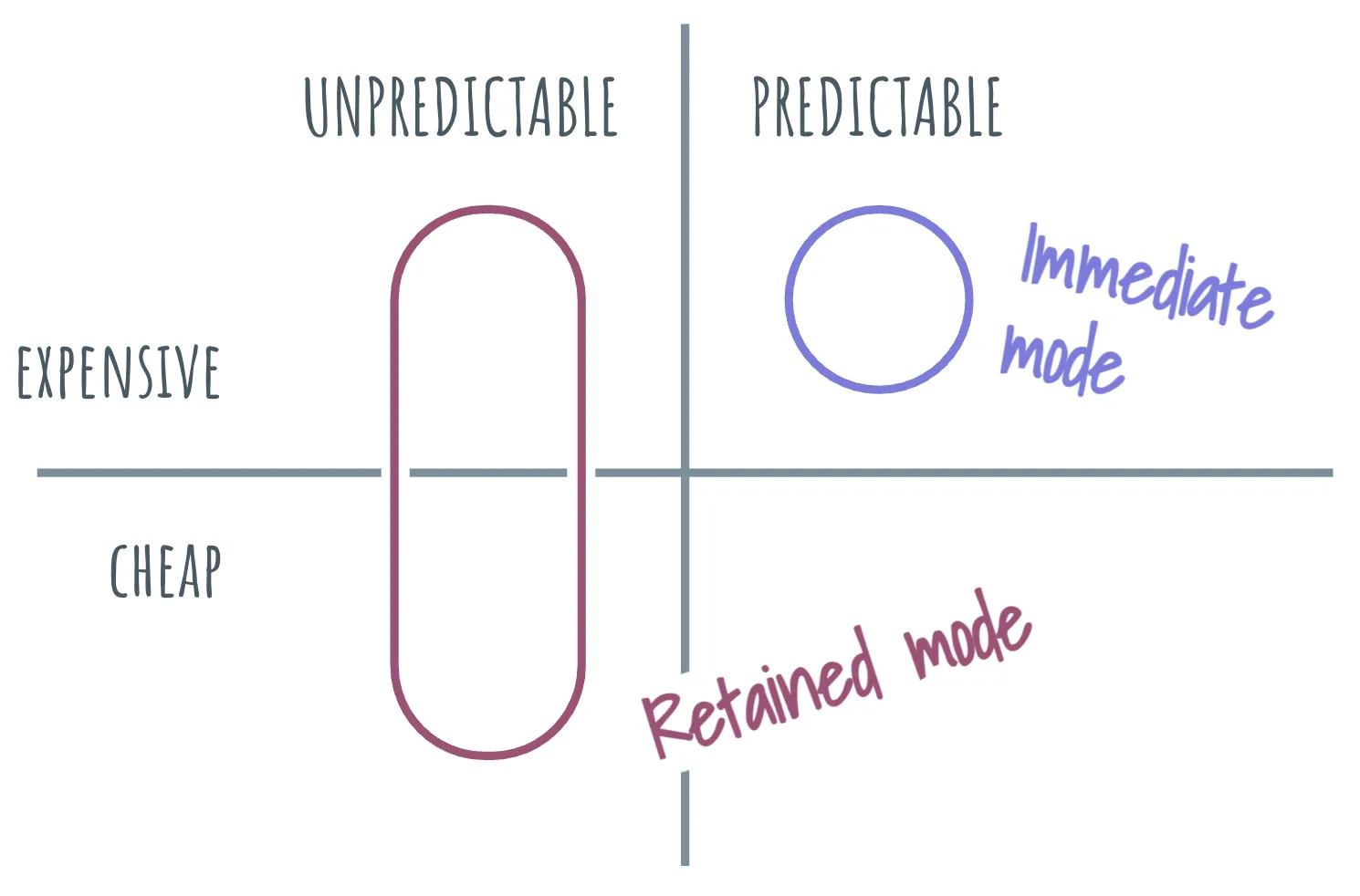
Both modes have their advantages and disadvantages. The immediate mode tends to need more effort and capacity to pay attention to the deluge of pixels, but it also offers a fairly predictable time-to-next-frame: if I can handle all these pixels for this frame, I can do so for the next frame. The retained mode can offer phenomenal benefits in saving the effort and do wonders when we have limited capacity. It also yields a “bursty” pattern of activity: for some frames, there’s no work to be done, while for others, the whole model needs to be rejiggered, causing us to blow the frame budget and generate jank.
Four layers2023An illustration for how this plays out is the abundance of the…
This trade-off between unpredictable burstiness and potential savings of effort is at the crux of most modern UI framework development. The key ingredient in this challenge is designing how the model is represented. How do elements of the screen relate to each other? What are the possible changes? How to make them inexpensive? How to remain flexible when new kinds of changes emerge?
The cost of opinion2022Below is the reasoning that went into this little ditty. The first…
The story of Document Object Model (DOM) can serve as a dramatic illustration. Born as a way to represent documents at the early beginning of Web, DOM has a strong bias toward the then-common metaphor of print pages: it’s a hierarchy of elements, starting with the title, body, headings, etc. As computing moved on from pages towards more interactive, fluid experiences, this bias became one of the greatest limiting factors in the evolution of the Web. Millennia — hell, probably eons — of collective brain-racking had been invested into overcoming these biases, with mixed results. Despite all the earnest effort, jank is ever-present in the Web. Unyieldingly, the original design of the model keeps bending the arc of the story toward the 1990s, generating phenomenal friction in the process.
Caring for elephants2022When Javascript was first introduced to the Web, the API to access…
The model underneaththe same dayIt will probably not come as a surprise to you that we…
OODA and Intentionlinks here, 2021The ability to make predictions is an astounding quality of retained-mode systems.…
In a weird poetic way, the story of DOM feels like the story of humanity: the struggle to overcome the limitations imposed by well-settled truths that are no longer relevant.
Show 1 comment
OODA and Intention – Dimitri Glazkov linked here · December 10, 2021
[…] ability to make predictions is an astounding quality of retained-mode systems. Unlike the imaginary immediate-mode beings, we can start seeing what might be. And we humans are […]