The Existential Anxieties31 days beforeSo far, I’ve talked about the general framework and the tensions between…
The Suffering of Expectations
The System of Self2019Existential Fears form the same pairwise polarities, the Existential Struggles, laid over…
I have been thinking about the relationship between expectations and suffering, and this framing popped out recently.
Embrace the suck2022Picture a simple framework. There are three attributes that can have positive…
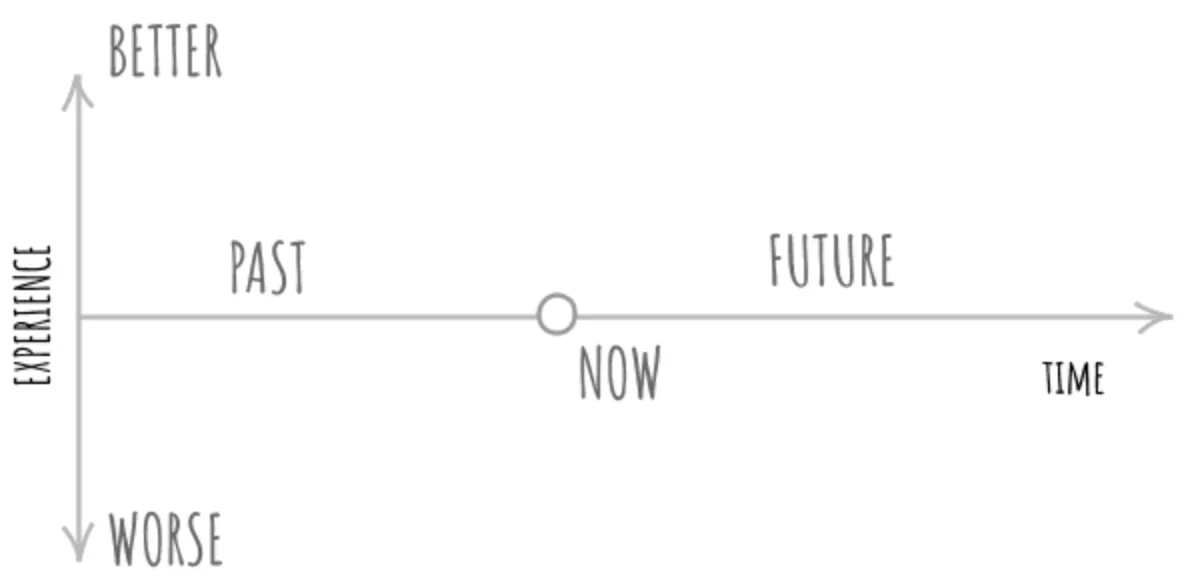
Let’s suppose that there’s a scale of experiences, spanning negative and positive. This scale is relative to the current moment, which we will consider the center of this scale. There’s some way in which we evaluate experiences and determine whether they are positive and negative. Adding the dimension of time, we get this continuum of experience.
Cravings and Aversions2021Though immediate effects of model flattening are already pretty dramatic, its largest…
Within this continuum, I can now frame our predictions of experiences and their outcomes as expectations. When we predict experiences to happen in a certain way, we create new expectations. When we look at the past and recall our experiences, we evaluate our prior expectations. My guess is that suffering is somehow related to encountering a difference–a delta–between our expectations of experiences and our actual experiences.
Behavior over time graphs and ways to influence2022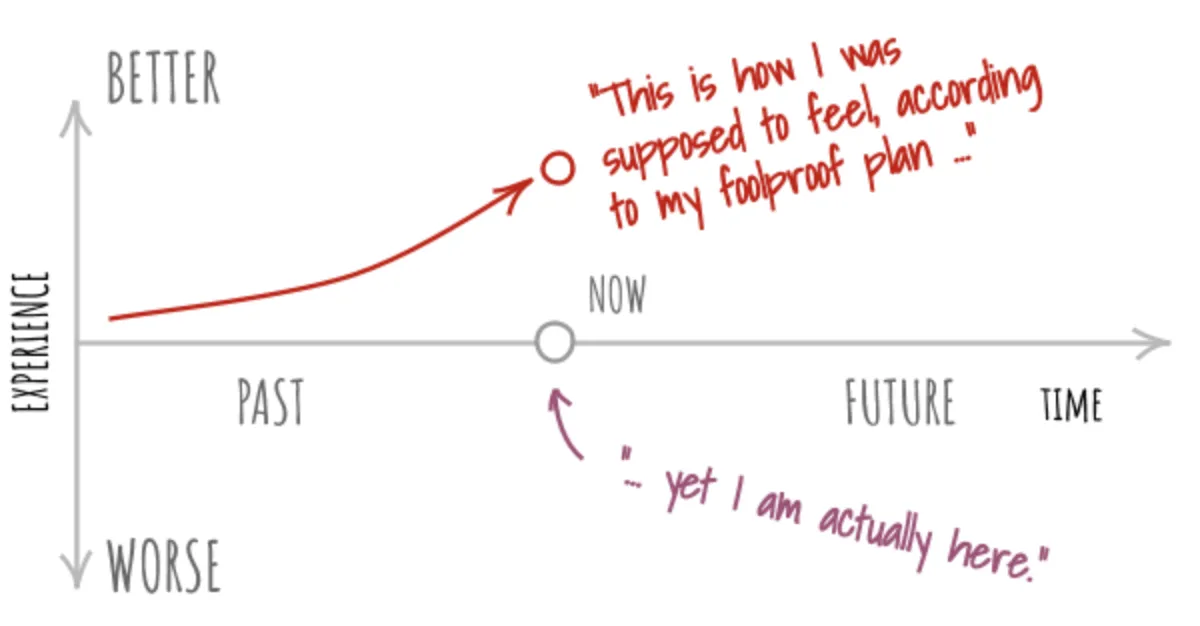
The OODA inside2021Because of the way we humans are wired, the expectation gradient is…
At every moment of time, we subconsciously evaluate two expectation deltas.
OODA and Intention2021The ability to make predictions is an astounding quality of retained-mode systems.…
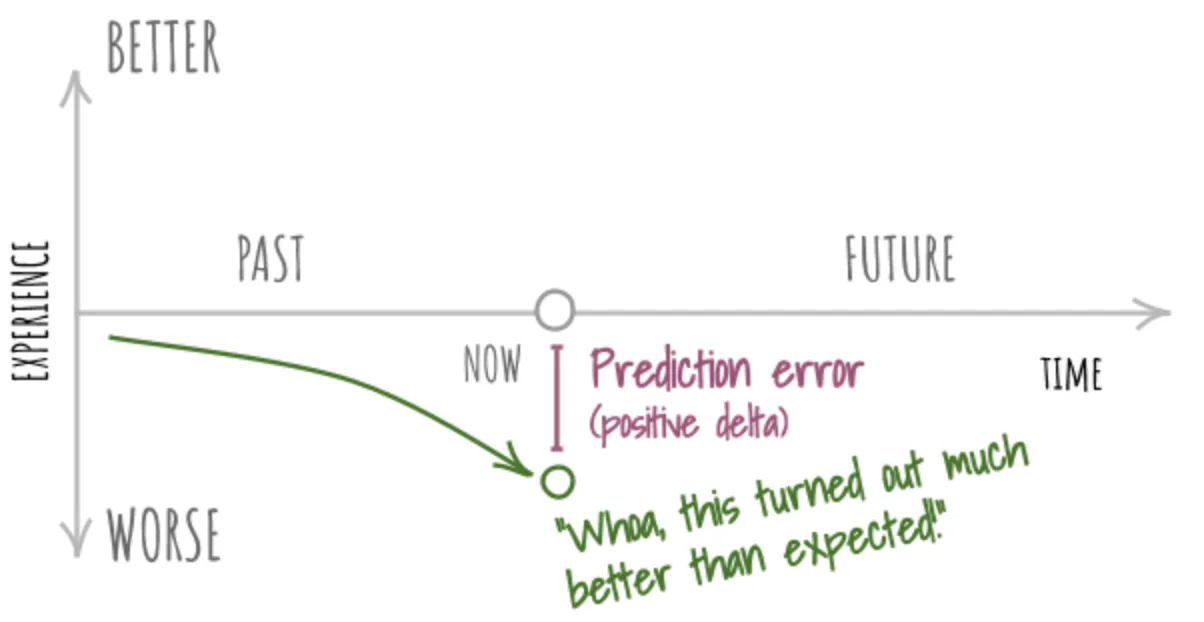
The first delta is the prediction error. It’s the difference between what I expected to happen now and what really happened. Let’s say that the prediction error value is positive when my expectations were exceeded–that is, when what really happened was better than what I expected to happen.
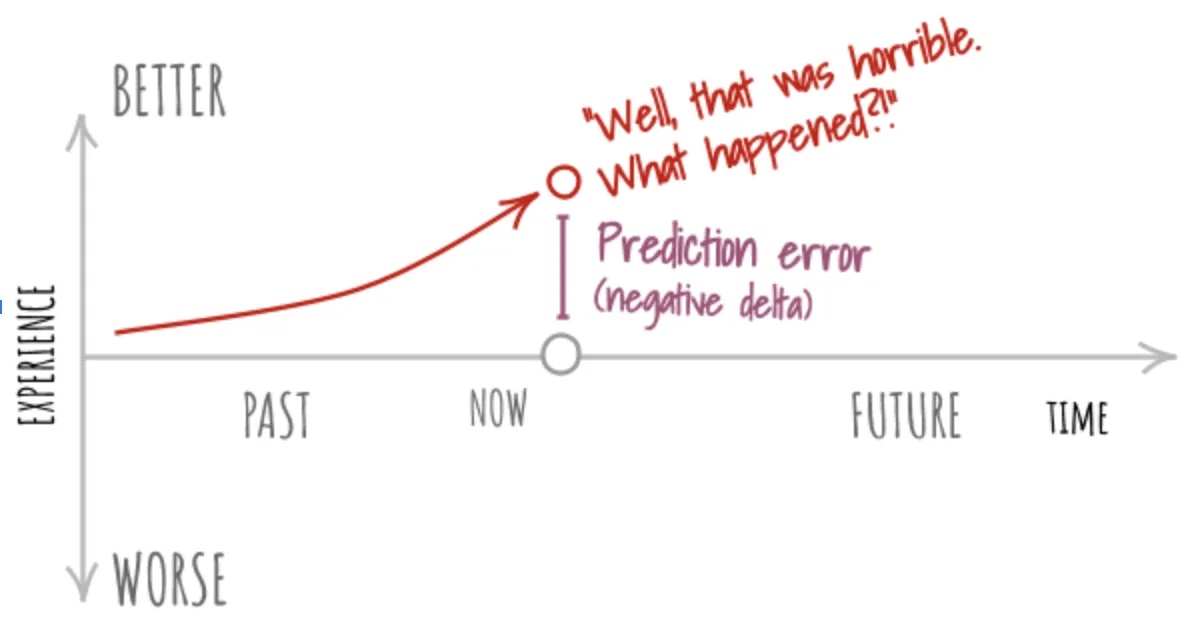
When my expectations were unmet–what happened was worse than what I expected to happen, let’s say that the prediction error value is negative.


The expectation gradient2021The conflation of “what is” and “what should be” is not the…
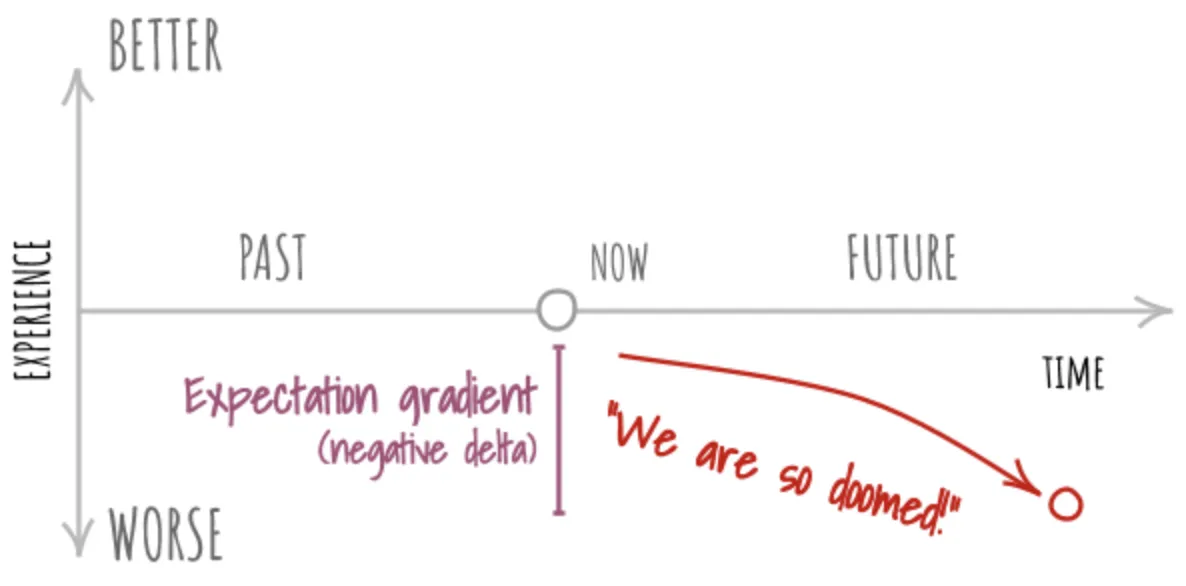
The second delta is the expectation gradient, or the difference between what I expect to happen in the future and what is currently happening. Let’s say that the expectation gradient value is positive when I expect better things to happen in the future …
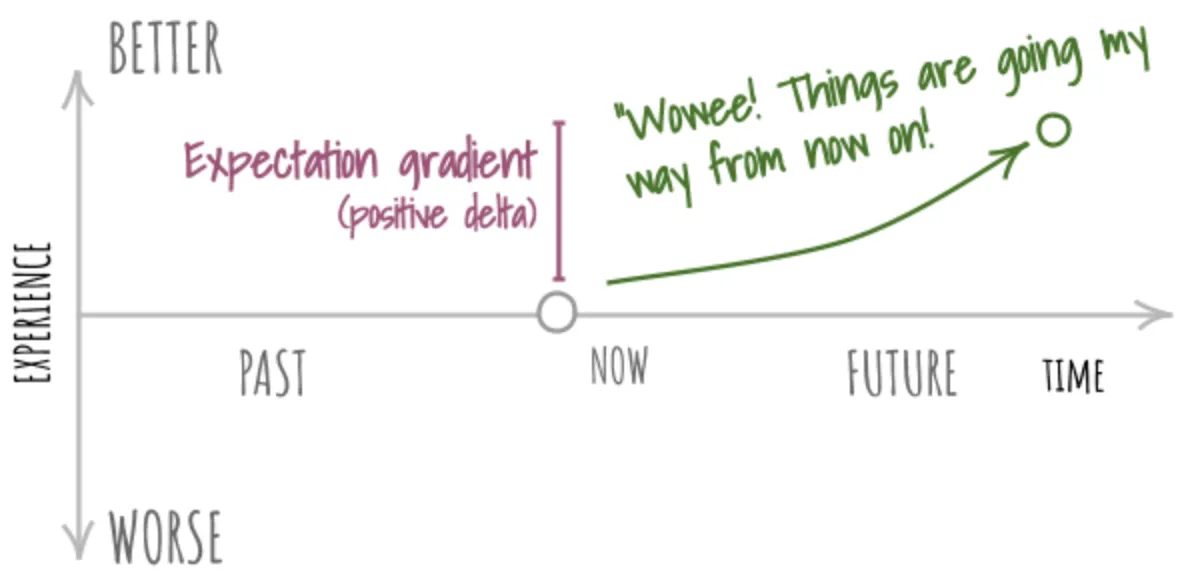
… and the value is negative when I expect the future to bring worse things.
Prediction errors and jank2021It seems that the retained mode is our way to compensate for…
Mental models2022I use the term “mental models” a lot, and so I figured…
Somatic Signals: How I use the Four Needs Frameworkseven days after, links hereViewed within the quadrants of the Four Needs Framework, the combinations of…
Transformational Learninglinks here, 2020Building on the ideas in The Suffering of Expectations, I want to…
There’s something about these negative deltas. The bigger they are, the more inaccurate the prediction, whether in the past or in the future. The less accurate the predictions, the stronger the signal about the inaccuracy of the model that was used to issue these predictions. I wonder if we humans interpret that signal as suffering. We are wired to reduce the strength of this signal, to reduce the suffering. And boy, do we try.
Show 2 comments
Somatic Signals: How I use the Four Needs Framework – Dimitri Glazkov linked here · August 30, 2020
[…] Asking these questions–gently and without judgement–usually yields insights about my state of expectations, or specific injured […]
Transformational Learning – Dimitri Glazkov linked here · October 11, 2020
[…] on the ideas in The Suffering of Expectations, I want to look more closely at the expectation gradients. These are predictions of future […]