If I don’t wake up, I stay asleep36 days beforeI had a beautiful experience early this morning. I was in the…
The Four Needs Framework
Learning from the nadir2023I’ve talked before about traps: how to get into them, what they…
Want, should, will2021While spelunking my network of assumptions, I often find it helpful to…
The story of agency2021Another kind of story that I’ve encountered in my exploration of coherence…
Of Love and Fear2019I am struck by the line I see between two kinds of…
The System of Self2019Here’s a checkpoint for Archeology of Self, a marker of where I’ve…
The stories we tell ourselves shape how we see the world around us. Sometimes, these stories are incomplete, lopsided in ways that aren’t obvious to us. A world viewed through the lens of such stories contains the suffering of inescapable traps, impossible choices, and paralyzing ambivalence. I want to share a framework with you that I found useful for adding a bit more depth to the stories, revealing more choices, and gaining a sense of direction. I developed it through my effort to discern the forces within myself, and have since applied it to help other people and organizations map their stories. I was inspired to see the framework resonate with others, and heartened to see them use it for wrangling with their challenges, helping refine the framework in the process.
The problem understanding framework2022When starting on this adventure, I wanted to construct a framework that…
What the heck is strategy work?2022So really, what this translates to so far is a strategist playing…
Settled and “not settled yet” framings2021I was working on decision-making frameworks this week and had a pretty…
This framework is more of a “feels like, seems like” tool rather than a rigorous scientific instrument. I think of it as a lightweight navigation aid for making sense of confounding situations.
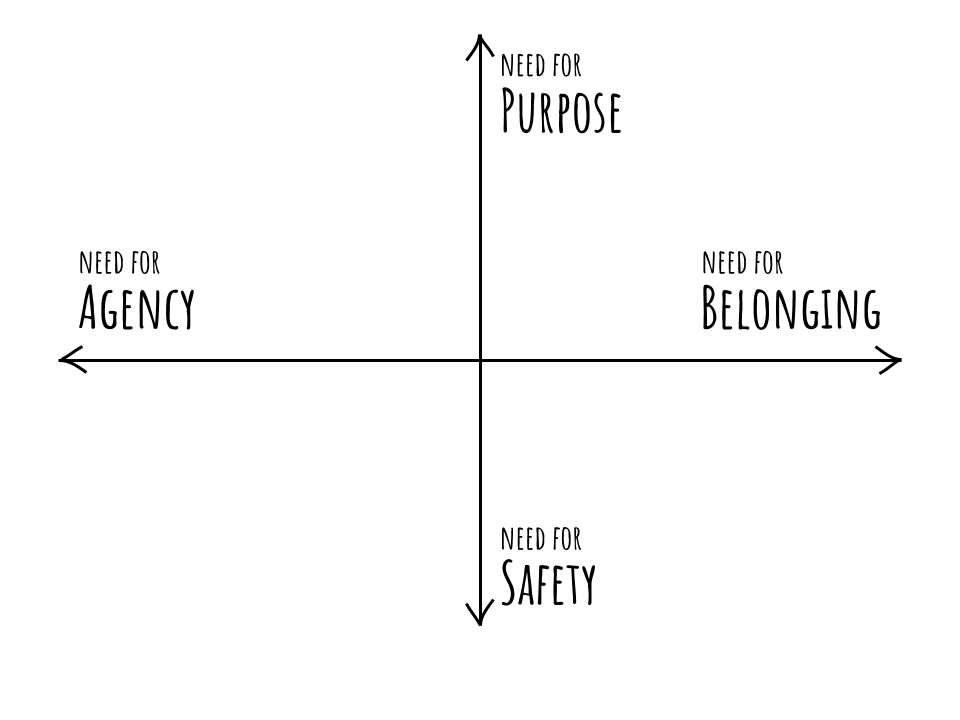
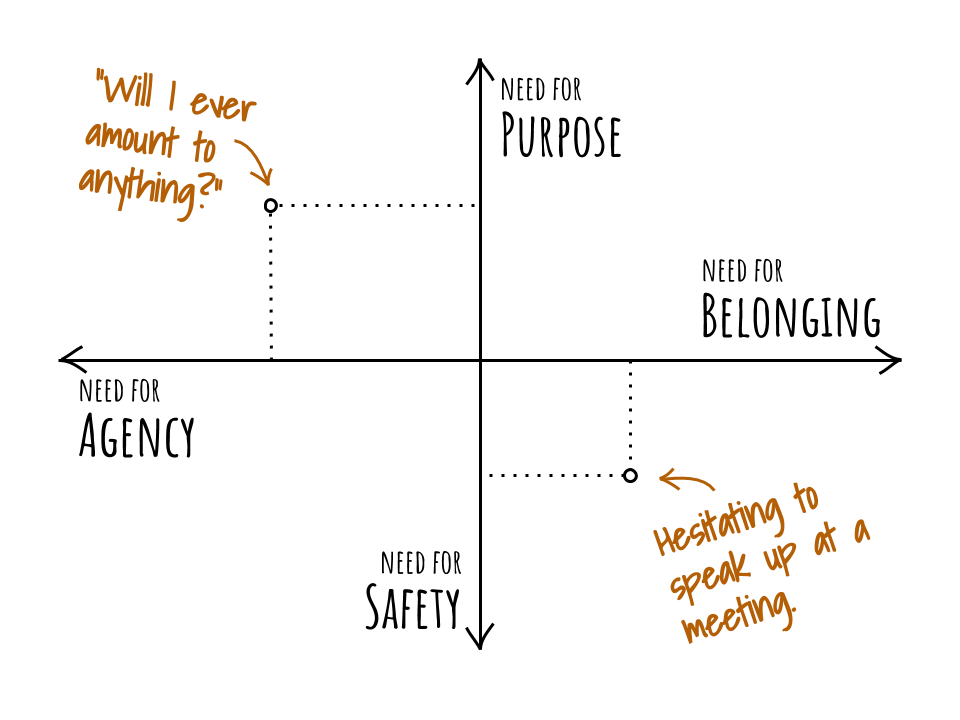
At the core of the framework, there is a four-quadrant coordinate space, formed by four needs in a pairwise tension with each other. The opposing needs that form the horizontal axis are Belonging (right) and Agency (left). The opposing needs that form the vertical axis are Safety (bottom) and Purpose (top).
Mindset transitions and coherence2021I wonder if in the framing of organizational mindsets, there’s a pattern…
These four quadrants are where the character’s story unfolds. At any given moment, the character is a point in this space. This character can be a person, a team, an organization, a family, or any social structure. Axes supply the coordinates within the space.
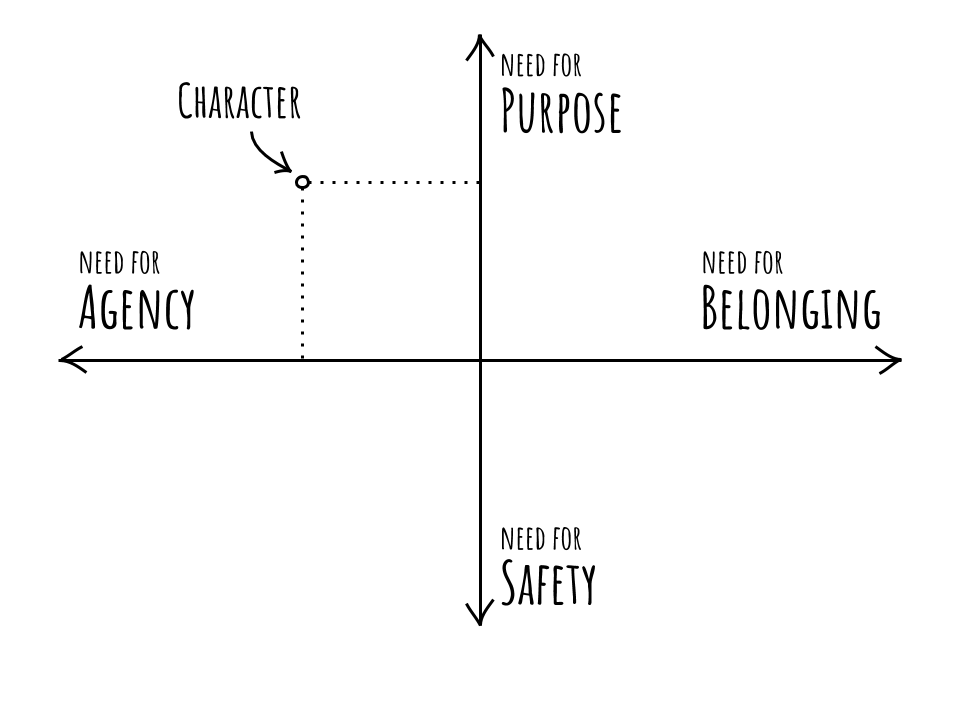
The coordinates reflect the tension between each of the paired needs. For a point that’s at the center–that is, equidistant between the extremes, the needs are perfectly balanced with each other. Points closer to either extreme reflect the imbalance: one need is dominating the other.
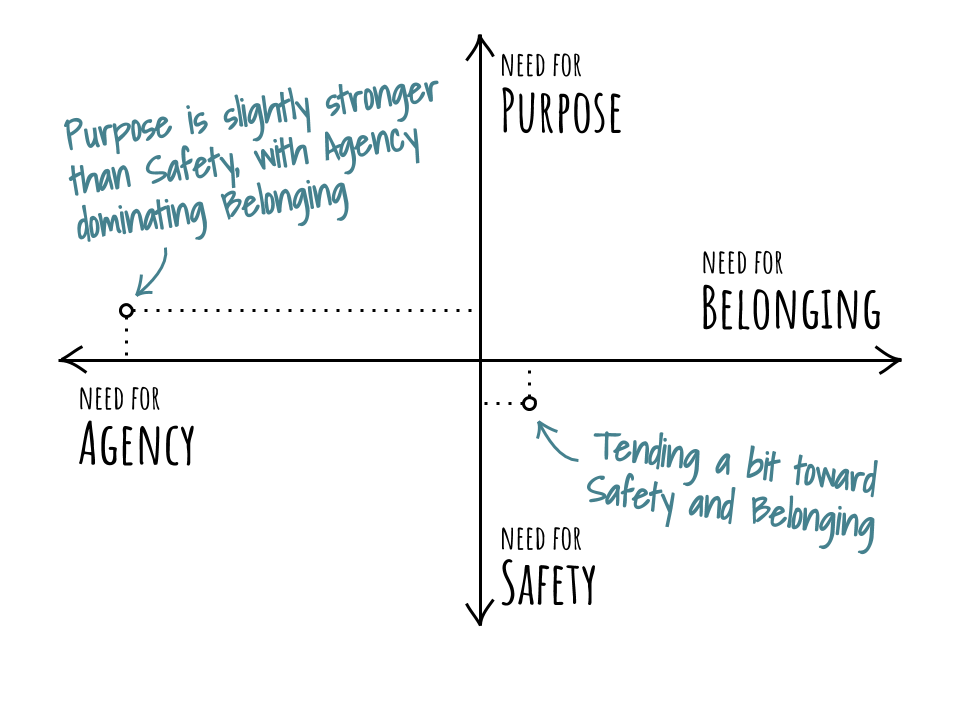
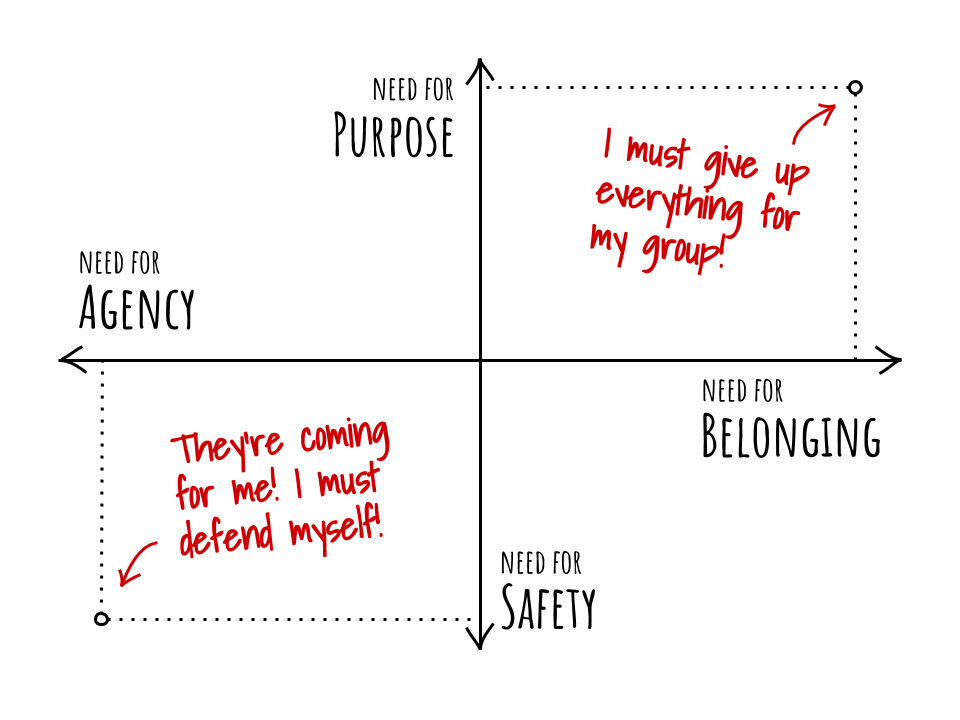
The farther to the extremes is the character, the more polarized the story becomes. At these extremes, needs are vastly outbalanced, becoming stark and existential. On the fringes of the coordinate space, there are drastic actions, emotional turmoil, sharp edges, spikes, and suffering. Everything is super high-contrast and feels like the matter of life and death. Needs turn into fears and impulsive drives. Safety becomes the literal matter of survival. Belonging — the terror of becoming invisible to others. Purpose transmutes into the horror of rotting alive. The need for Agency explodes into panic of dissolving into the mass of others.
The third option2024The deeper insight here is that we are surrounded by polarities. Behind…
The closer to the center, the more balanced and nuanced the story. The tugs of the needs become subtle, needing more care to discern. Things may seem “normal” or “business as usual”, yet there’s usually a nagging feeling of ambivalence, something being off.
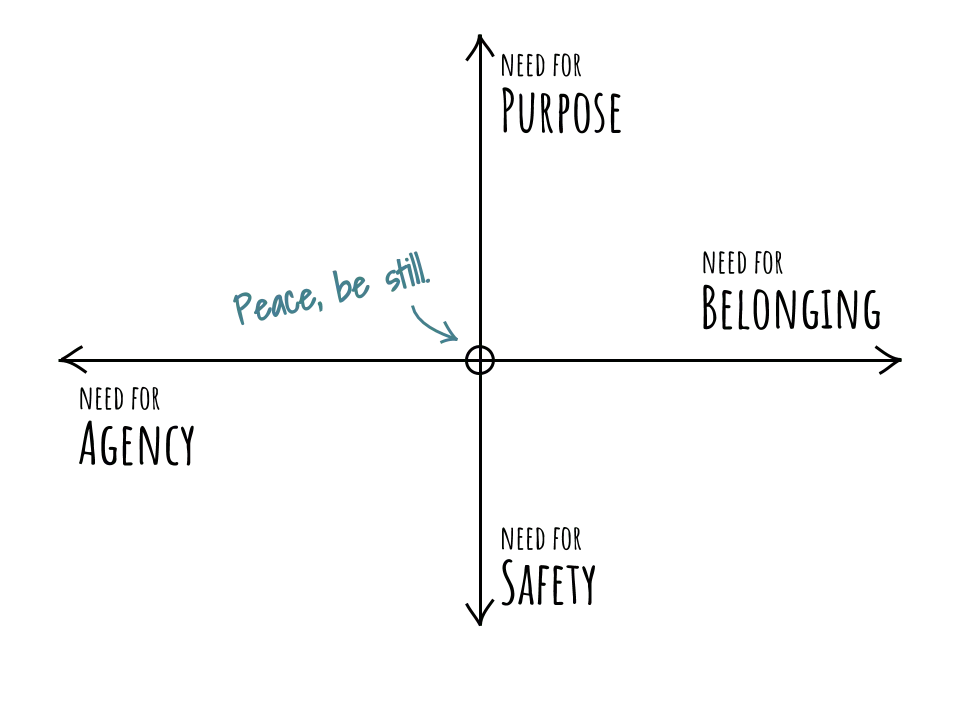
At the center, all needs are balanced in perfect harmony with each other. No need is heard stronger than others, and the character is at peace. Here, all needs are still present and are just as forceful, yet the character is able to see them and masterfully maintain the delicate balance.
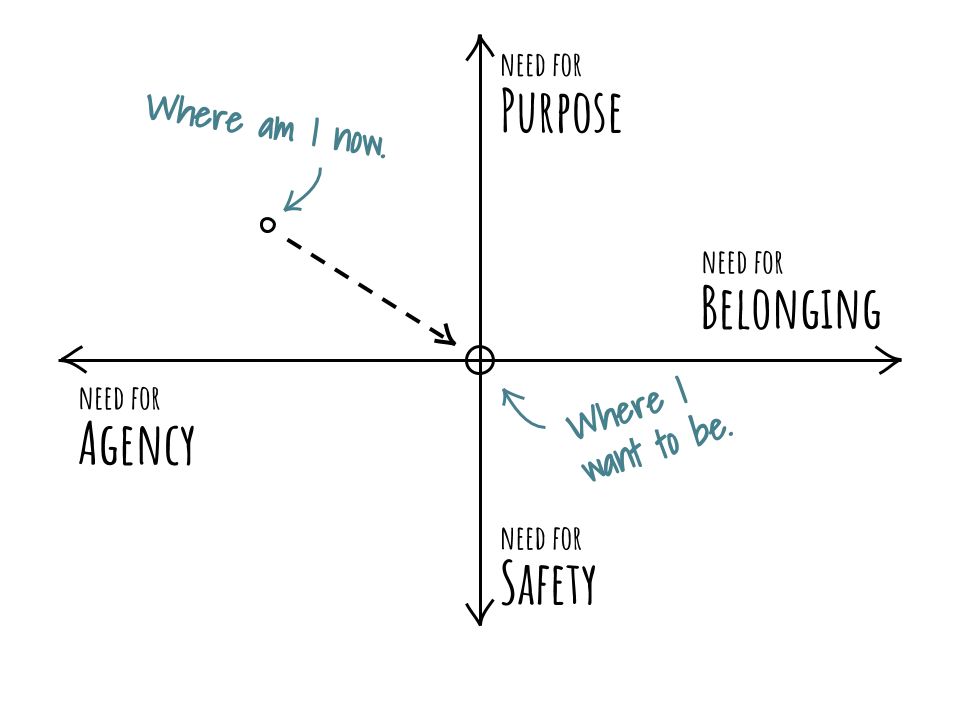
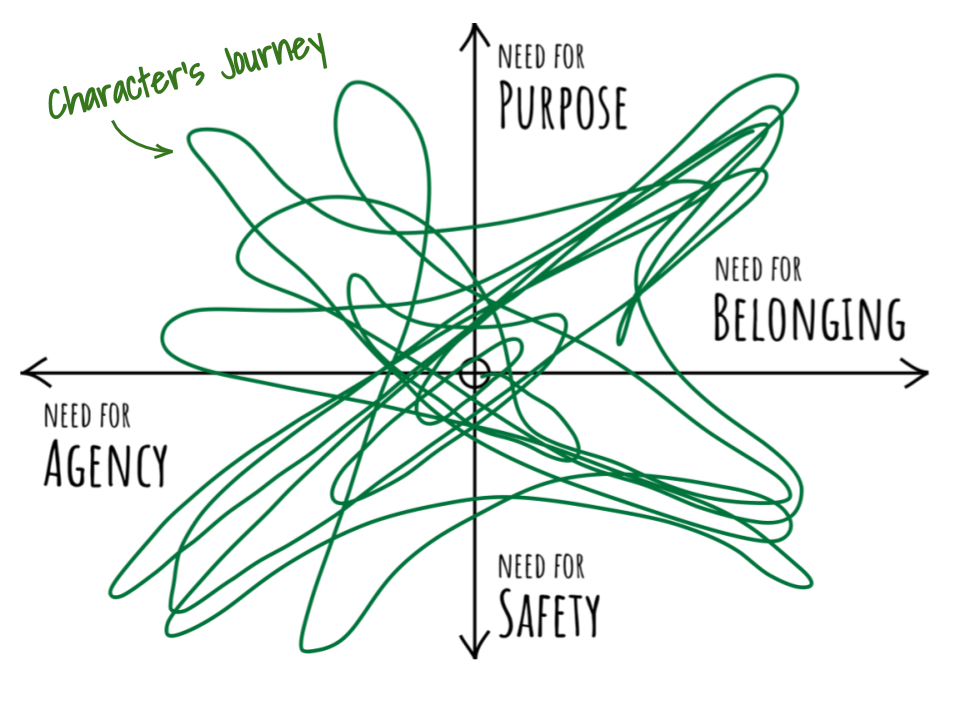
The neat effect of this arrangement of the coordinate space is that the framework becomes directional: there is a clear destination, something to move toward. There’s a built-in compass of sorts. Getting to center is the nature of the character’s journey.
OO and DA2021Each presents two different configurations for the OODA loop: I’ll call them…
In practice, the journey rarely ends up looking like a direct line. Like in an endless tug of war, each of the four needs competes for the character’s attention and usurps it when the attention is granted. Instead of arriving at center, the shift in the balance tends to “overshoot” the character over to the adjacent quadrants.
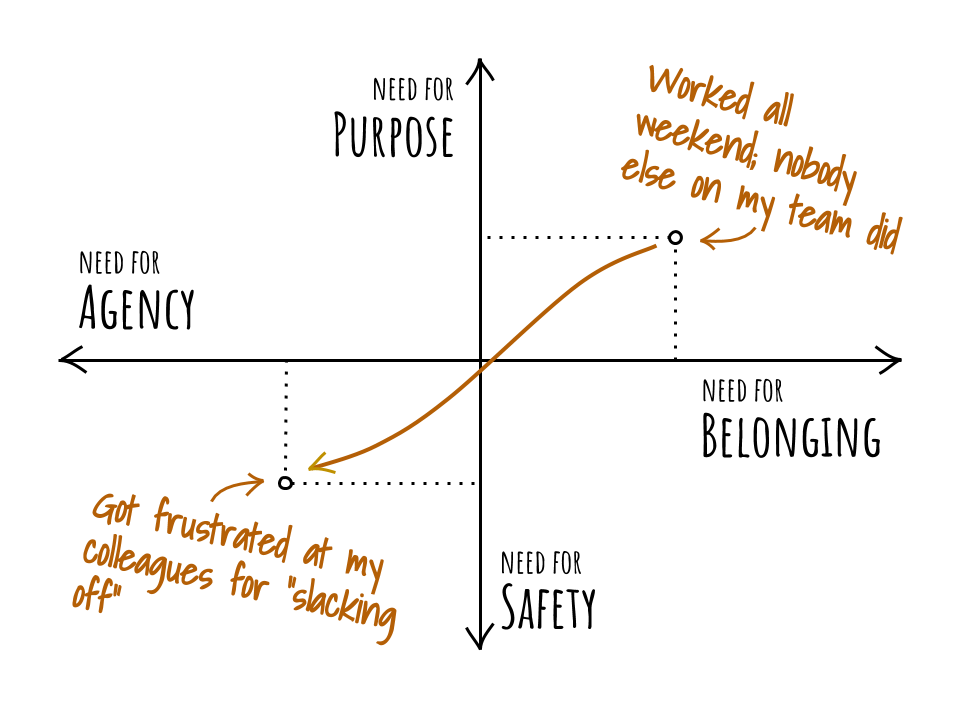
And so the journey ends up looking like a chaotic meandering from one quadrant from another, an enduring quest for peace.
Practices to break out of the cycle of not-learning2022At each step in the vicious cycle of not-learning, there is a…
To reach the center, the character must transform. They must learn to have simultaneous attention on all four needs, to gently balance them in the moment. The character needs to become aware of the needs, learn to see them and the tension between them.
The Perspective Ladder2022I hope this illustration has been helpful. I have been using a…
This is the basic setup of the framework. For me, its value has been in having a structured way of looking at a situation, finding the story that is being told and revealing new ways to see that story. Who is the character in the story? What words do I use to describe the character’s needs? What do these words tell me about the character’s position in the coordinate space? What led to them being there? What are the hopes and aspirations of the character for each quadrant? What are the fears? What does being at center feel like?
Letting My Purpose Find Me2019In my own clock, I spoke metaphorically about learning to listen to…
The tension between Agency and Belongingseven days after, links hereIn the Four Needs framework, I identified a tension between two opposing…
Tension between Purpose and Safetylinks here, 2020Within the framing of the the Four Needs framework, there’s a story…
The Existential Anxietieslinks here, 2020So far, I’ve talked about the general framework and the tensions between…
The story of belonginglinks here, 2021Next in my adventure across the coherence narrative realm is the story…
My experience is that with each answer, the story gains a bit more depth, more subtlety, and allows me to see more choices, more opportunities and clarity of direction. I hope you’ll find it useful in your character’s journey toward the center.
Show 5 comments
Taryn Sexton · February 23, 2020
Hi Dimitri,
This model resonates strongly with me personally at the moment, thank you! In particular, I found the tension between purpose and safety quote relevant and enlightening as I hadn’t previously framed these two concepts as a polarity.
Thank you for sharing.
Taryn
Dr. Penny Potter · March 1, 2020
This is a simple and elegant framework that is useful to assess where we are at any given time. If you flip belonging and agency, it mirrors the Leadership Circle Profile model. In this simplified form it is abundantly useful.
The tension between Agency and Beloging – Dimitri Glazkov linked here · March 1, 2020
[…] the Four Needs framework, I identified a tension between two opposing forces: the need for Agency and the need for […]
Tension between Purpose and Safety – Dimitri Glazkov linked here · July 8, 2020
[…] the framing of the the Four Needs framework, there’s a story being told, and I find that looking at the story through the eyes of the […]
The Existential Anxieties – Dimitri Glazkov linked here · July 23, 2020
[…] far, I’ve talked about the general framework and the tensions between the needs. To explore how the character moves across the Four Needs […]